How to Build a 3D Product Configurator: Stack and Build vs Buy

Category:
What Is a Digital Thread? Definition, Lifecycle, and Where It Breaks
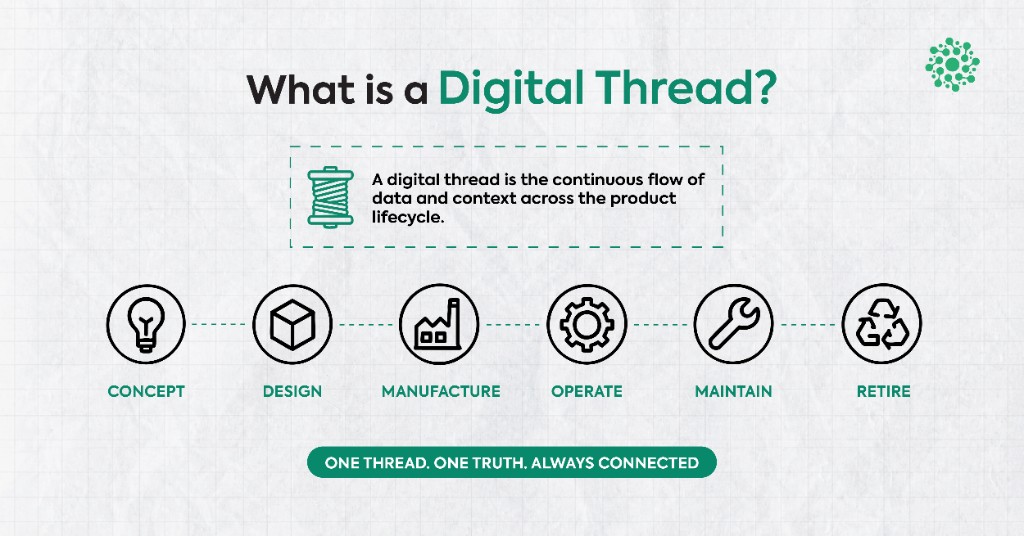
A digital thread is a connected data architecture that links product information across the entire lifecycle, from design and engineering through manufacturing, quality, and in-service support, so any stakeholder can trace a decision back to its authoritative source. It is not a single system or a piece of software. It is the connective structure between the systems you already run.
The peer-reviewed definition is narrower and worth having alongside the plain-English one. Singh and Willcox put it this way in the AIAA Journal in 2018. A digital thread is "a data-driven architecture that links together information generated from across the product lifecycle," one "envisioned to be the primary or authoritative data and communication platform for a company's products at any instance of time" (Engineering Design with Digital Thread).
The term appears constantly in vendor decks and is almost never defined without a product attached to it. This guide defines it and maps it across the lifecycle. It sorts out how the thread relates to PLM and MBSE. Then, using a 2026 study of aerospace and defense leaders, it says plainly where the thread breaks.
Key Takeaways
- A digital thread is an architecture, not a product. It connects systems; it isn't one.
- It runs both directions: forward from requirements to service, and back again. The return path is the part that usually doesn't exist.
- PLM is a system, MBSE is a method, the digital thread is the architecture that connects them outward. A digital twin is an instance — one thread can support many twins.
- In 2026, three-quarters of aerospace and defense organizations were implementing a digital thread, but only 14% had it applied enterprise-wide (EY and the Aerospace Industries Association, 2026 A&D Digital Thread Study, n=57).
- It breaks on ownership and governance before it breaks on technology. Only 29% of those leaders called their enterprise data standardized, governed, and accessible.
What is a digital thread?
A digital thread is the connected data structure that makes product information traceable across its whole life. A question asked in service gets answered from the same authoritative definition engineering created. It is not a database, a platform, or a purchase. It is how the things you already own relate to each other.
The word doing the work is authoritative. Plenty of organizations can move data between systems. Far fewer can say, for any given fact about a product, which copy is the one that governs. A digital thread is what makes that answerable.
The term has a specific origin, which is unusual for something this widely used. It first appears in Global Horizons, the U.S. Air Force Global Science and Technology Vision report published on 21 June 2013 as AF/ST TR 13-01 (U.S. Air Force). It was then developed in practice on the F-35 program, with Lockheed Martin and the Air Force Research Laboratory. Victor Singh and Karen Willcox at MIT gave it a formal mathematical treatment in 2018.
Standards bodies took it from there. NIST ran a Digital Thread for Manufacturing program from October 2021 until its completion. It tied the concept to a specific stack of standards rather than to any vendor. Those were STEP (ISO 10303), the Quality Information Framework (ISO 23952:2020), MTConnect, and the ASME Y14 series for dimensioning and tolerancing (NIST). NIST reported that its pilots showed model-based product definition standards reducing design-to-manufacturing cycle time and improving final part quality.
That standards list is the most useful thing in the definition. A digital thread isn't an abstraction — it runs on neutral formats. If you want the foundation of that, we've written up what a STEP file is and which application protocol to export.
The digital thread across the product lifecycle
The thread runs from requirements through design, simulation, manufacturing planning, production, quality, and service — and then back to requirements. Its value isn't the forward path, which most organizations manage tolerably. It's the ability of any stage to trace back to the authoritative definition instead of to a copy of it.
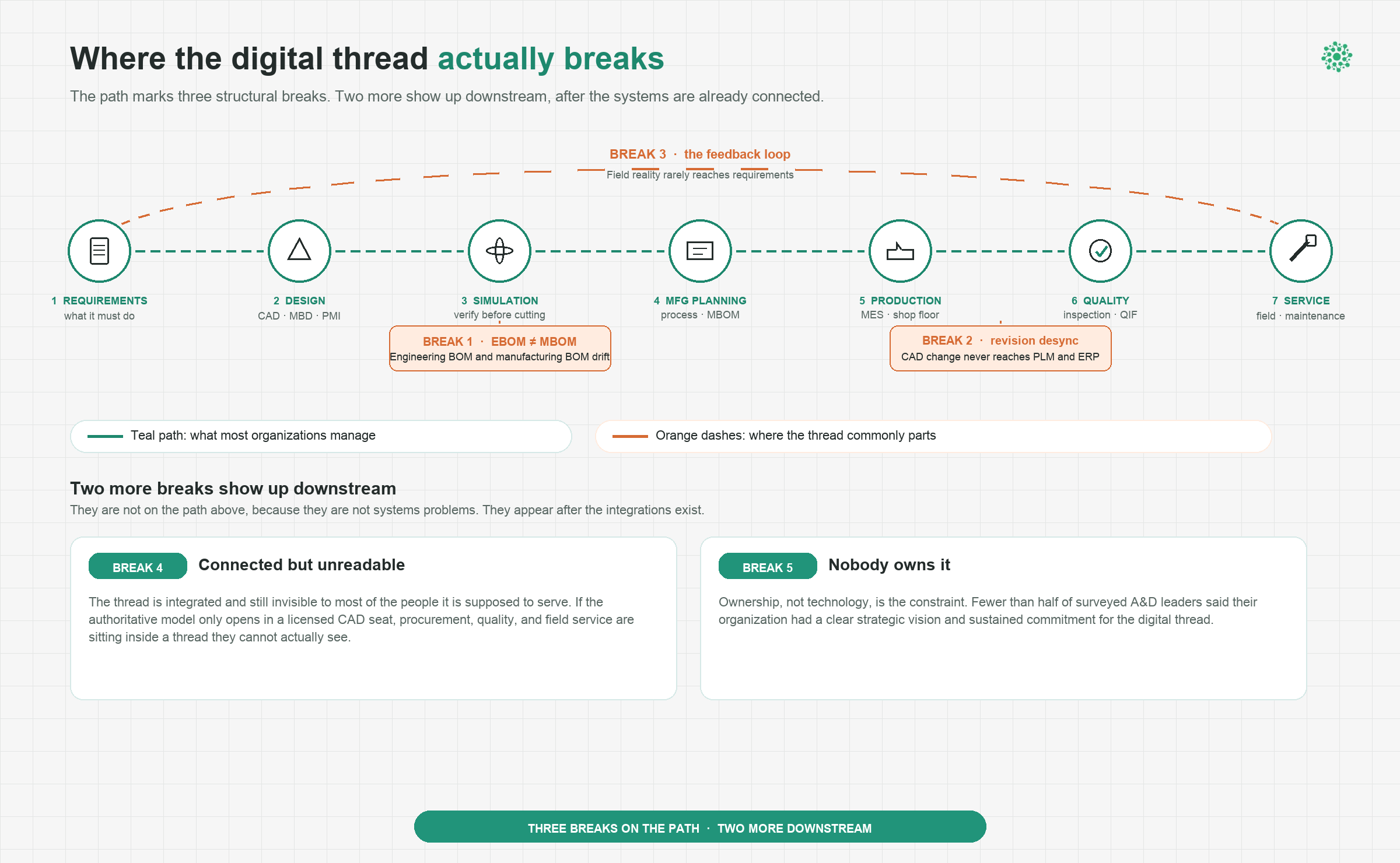
Walk it forward and the data changes shape at every stage. Requirements are text and constraints. Design produces geometry, model-based definition, and product manufacturing information. Simulation produces results tied to a specific revision. Manufacturing planning turns the engineering bill of materials into a manufacturing one. Production produces build records. Quality produces measurements — which is where QIF earns its place, because inspection results carry identifiers that point back at the originating design features.
Then service produces the most valuable data in the whole chain, and in most organizations it goes nowhere. That's the orange arc on the diagram, and it's the difference between a thread and a pipeline.
What makes the return path hard isn't transport. Field data arrives in a different shape from everything upstream: failure codes, technician notes, photographs, sensor histories. None of it maps cleanly onto a requirement or a tolerance. Closing the loop means deciding, deliberately, which field observations are allowed to change the authoritative definition and who signs off on that. Most organizations never make that decision, so the data lands in a service system and stays there.
How do the digital thread, PLM, and MBSE fit together?
PLM is a system, MBSE is a method, and the digital thread is the architecture that connects them to everything downstream. These are not competing purchases, and treating them as alternatives is the most common conceptual error in this whole area.
PLM is the system of record for product data. It's usually the thread's backbone, and a well-run PLM instance is close to a prerequisite. But owning PLM is not owning a digital thread, and a thread that stops at PLM's boundary isn't one either — the point is what happens after the data leaves.
MBSE is a method for the front of the lifecycle and a subset of digital engineering. It's frequently the entry point: MBSE produces authoritative models early, during requirements and system design, and the thread is what carries those models forward into production, operation, and maintenance. MBSE without a thread produces excellent models that nobody downstream ever sees.
A digital twin is an instance. It's a live, synchronized model of one specific unit or asset, fed by sensor data. The relationship is one-to-many: one thread can support many twins.
Digital thread
- What it is: an architecture
- Where in the lifecycle: end to end, both directions
- What it produces: traceability to an authoritative source
- Common misconception: that you can buy one
PLM
- What it is: a system
- Where in the lifecycle: centre of gravity, design onward
- What it produces: a managed system of record
- Common misconception: that having it means having a thread
MBSE
- What it is: a method
- Where in the lifecycle: front end — requirements, system design
- What it produces: authoritative early models
- Common misconception: that it's a modelling tool rather than a discipline
Digital twin
- What it is: an instance
- Where in the lifecycle: operation and service
- What it produces: a live mirror of one real asset
- Common misconception: that it works without a thread beneath it
There's a practical test buried in that comparison. If you can't say which system holds the governing copy of a given fact, you have integrations, not a thread. For the visibility layer that sits on top of all of this, see making 3D accessible across the organization.
Three industries where the digital thread matters most
The digital thread shows up hardest where something external forces the issue — a certification body, a regulator, or a source of truth that won't hold still. Three sectors, three different forcing functions.
Aerospace and defense: configuration management, and a reality check
This is where the concept came from, and it's where adoption is most mature — which makes it the honest place to look at results. In June 2026, EY and the Aerospace Industries Association surveyed 57 A&D leaders, all at U.S. AIA member companies with revenues above $100 million and at least three years of digital thread investment. They found 87% familiar with the concept and 72% with implementation underway, but only one in seven reporting true enterprise-wide implementation (Manufacturing Dive on the EY/AIA study).
Forcing function: configuration management across programs measured in decades. An airframe delivered in 2010 still needs its as-built definition in 2040, including which specific part revision went into which tail number. No commercial system is guaranteed to outlive the asset, which is why neutral formats matter more here than anywhere else.
Medical devices: you have to be able to prove it
Regulation does the forcing here, and it now has a date attached. The FDA's Quality Management System Regulation took effect on 2 February 2026, incorporating ISO 13485:2016 by reference and replacing the old Quality System Regulation (FDA). Unique Device Identification enforcement has pushed traceability down to component level for Class II and III devices.
What that demands is a connected record from user needs through risk analysis, design verification, process validation, and post-market surveillance. That record is a digital thread, whether or not anyone in the building calls it one.
The difference from aerospace is the direction of proof. A&D needs to know what it built; a device manufacturer needs to demonstrate, to an inspector, that the thing it built is the thing the design controls required. Traceability has to be legible to someone outside the company, which raises the bar on documentation rather than on integration.
Forcing function: a Design History File that has to survive an inspection.
Energy and heavy industry: the source of truth moves
Solar, mining, and oil and gas build from survey and site data rather than a fixed catalog, so the authoritative model is continuously regenerated rather than released once. The thread has to carry geometry that changes with the ground.
We've built in this space directly. For Enact Systems we developed a browser-based solar design engine with plane-fitting roof detection from noisy Digital Surface Model data and a virtual sun-movement engine for shadow simulation. For Strayos the source data comes off mining sites. In both, the hard part wasn't connecting systems. It was deciding what counted as authoritative when the site itself keeps changing.
Forcing function: the source of truth is regenerated, not released. That inverts the usual assumption. In discrete manufacturing the authoritative model is a released artifact that changes through a controlled process. On a solar rooftop or a mine bench, it's the output of a survey that could be repeated tomorrow. Version control has to track the survey as much as the design.
(Automotive is the fourth obvious candidate. We've covered it separately in why the digital thread breaks between customer-facing teams and engineering. That piece looks at handoffs rather than lifecycle structure.)
Where the digital thread actually breaks
The thread breaks at handoffs between systems that were never designed to agree — and more often, at the point where nobody owns the whole thing. In 2026, only 29% of the A&D leaders EY and the AIA surveyed said their enterprise data was standardized, governed, and accessible (EY/AIA, 2026 A&D Digital Thread Study). Everything else in this section follows from that one number.
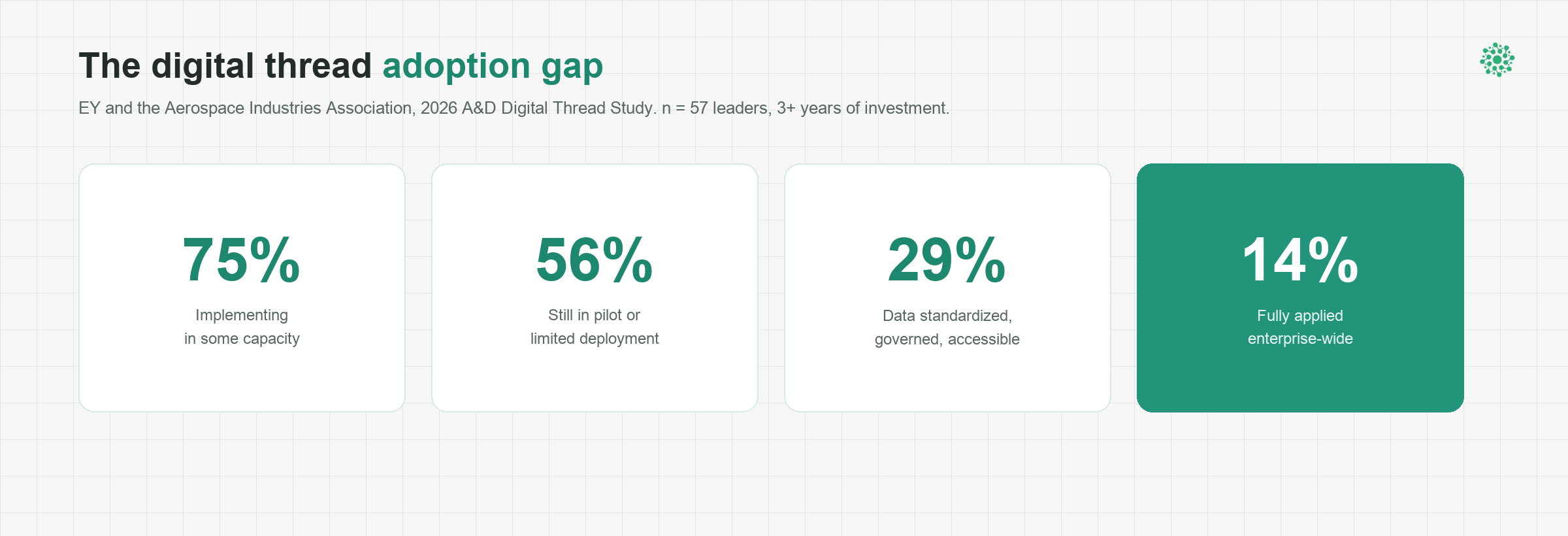
Five break points, roughly in the order they cost money. The first three are the ones marked on the lifecycle diagram. The last two show up downstream, after the systems are already connected.
1. The engineering and manufacturing bills of material diverge. The EBOM describes what was designed; the MBOM describes what gets built. When they drift apart, procurement buys against the wrong structure and the error surfaces at receiving or later.
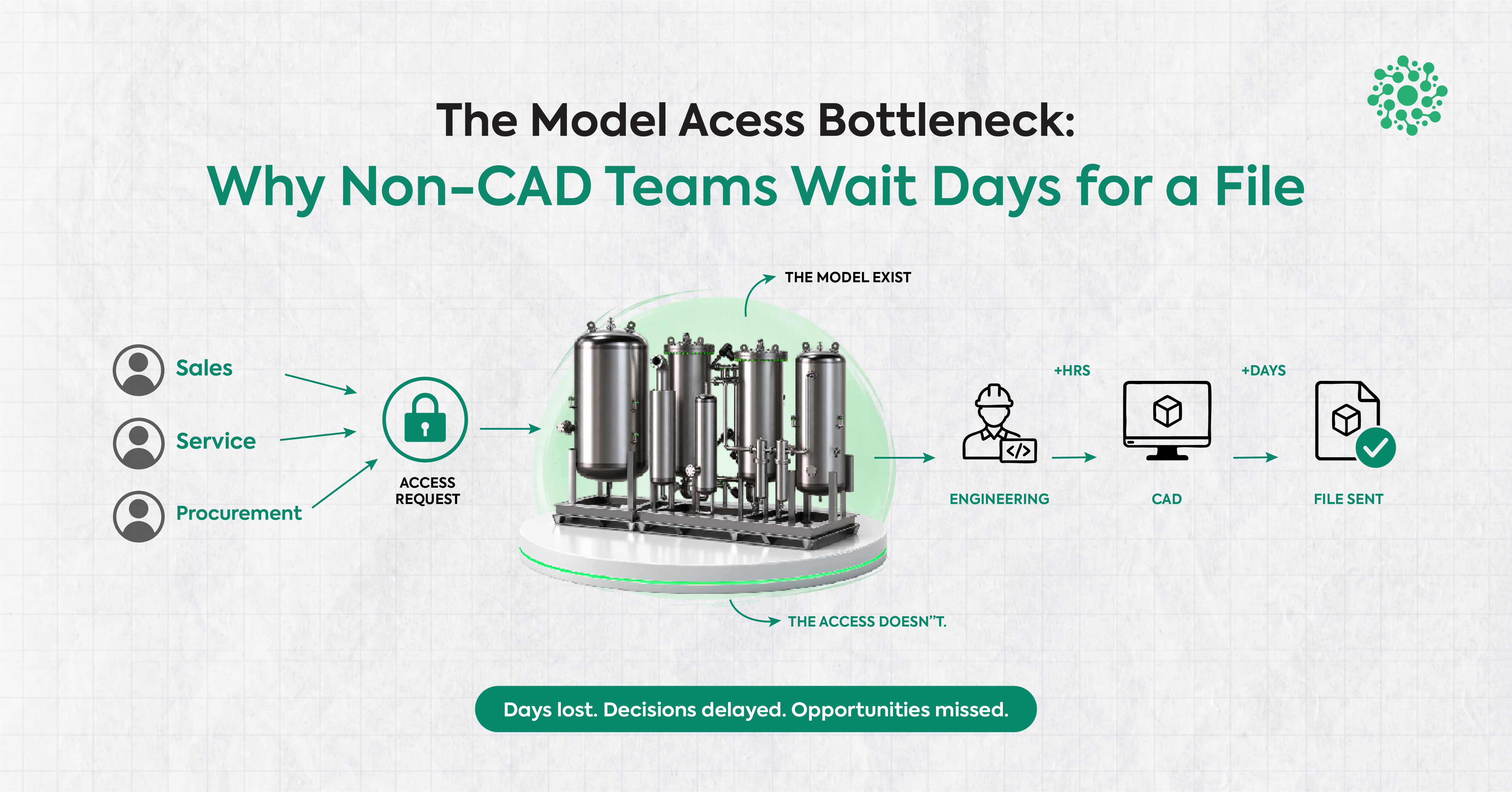
2. Revisions fall out of sync. A change lands in CAD and doesn't propagate to PLM and ERP automatically, so production runs against a superseded revision. Nothing in the file announces that it's stale. We've costed one version of this problem in the model access bottleneck.
3. The service feedback loop never closes. Data flows forward and stops. What actually failed in the field, and why, doesn't reach requirements. This is the least discussed break and arguably the most expensive, because it's the one that would have improved the next product.
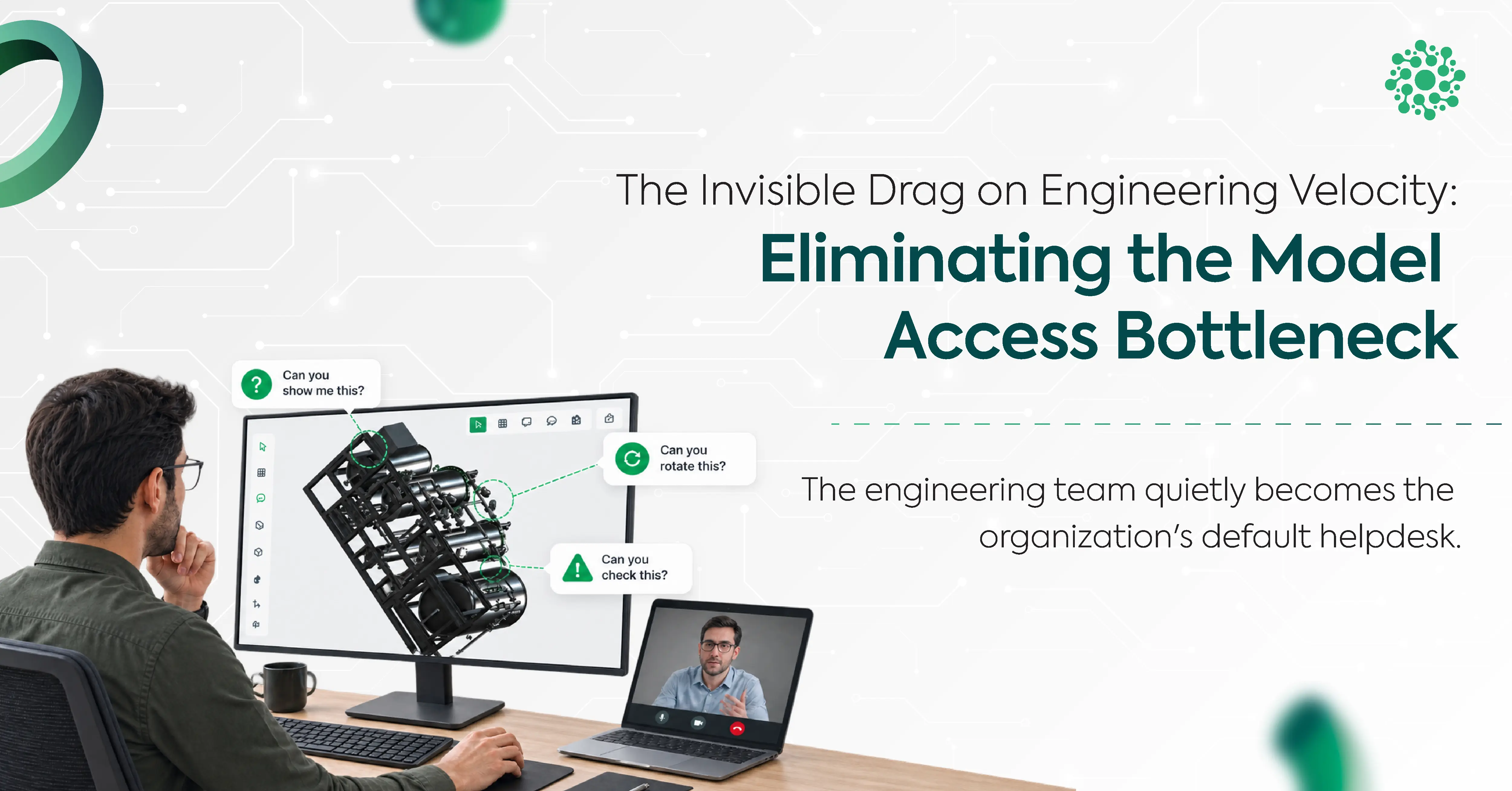
4. The thread is connected but unreadable. This one doesn't appear on vendor diagrams because it isn't a systems problem. A thread can be perfectly integrated and still be invisible to most of the people it's supposed to serve. If the authoritative model only opens in a licensed CAD seat, then procurement, quality, and field service are sitting inside a thread they cannot actually see. Connectivity is not access, and access is what traceability means in practice.
5. Nobody owns it. The study puts this first, and it's worth taking seriously. Fewer than half — 45% — of the surveyed leaders said their organization had a clear strategic vision and sustained commitment for the digital thread. The interview finding was blunt: ownership, not technology, is the constraint.
That last point reframes the whole problem. If 56% of well-funded organizations with three or more years of investment are still in pilots, the missing ingredient probably isn't another integration layer. It's someone whose job is the thread itself rather than one of the systems it passes through.
Digital thread vs digital twin
The digital thread is the architecture; the digital twin is an instance. The thread is connected, governed product data spanning design, manufacturing, service, and end of life. The twin is a live, synchronized model of one specific unit, fed by sensor data and operational feedback.
The relationship is one-to-many. One thread supports many twins — a twin per aircraft tail number, per pump, per installed system. Each twin draws its definition from the thread and writes its operating history back to it.
Which makes the failure mode easy to spot. A twin without a thread underneath it has no authoritative definition to synchronize against. It can show you live sensor data, but it can't tell you whether the asset matches what was designed. That's a demonstration, not a system of record — and it's a common outcome when a twin pilot is funded before the data governance work is done.
Worth its own guide, and we'll write one. For now: if someone is selling you a twin and hasn't asked about your thread, ask why not.
Frequently Asked Questions
What is a digital thread in manufacturing?
A digital thread is a connected data architecture linking product information from design through manufacturing, quality, and service, so any stage can trace back to the authoritative source. NIST tied it to a specific standards stack: STEP (ISO 10303), QIF (ISO 23952:2020), MTConnect, and ASME Y14.
What's the difference between a digital thread and a digital twin?
The thread is an architecture; the twin is an instance. One thread can support many twins — one per physical asset. A twin draws its definition from the thread and writes operating data back. Without a thread beneath it, a twin has no authoritative definition to synchronize against.
Is the digital thread the same as PLM?
No. PLM is a system of record and usually the thread's backbone, but owning PLM doesn't mean having a digital thread. The thread is the architecture connecting PLM outward to ERP, MES, quality, and service. A thread that stops at PLM's boundary isn't one.
Who coined the term digital thread?
It first appears in Global Horizons, the U.S. Air Force Global Science and Technology Vision report published 21 June 2013 as AF/ST TR 13-01. It developed in practice on the F-35 program with Lockheed Martin and AFRL, and was formalized academically by Singh and Willcox in the AIAA Journal in 2018.
Why do digital thread projects stall?
Ownership and data governance, not technology. In 2026, EY and the Aerospace Industries Association found only 14% of surveyed A&D organizations had a digital thread applied enterprise-wide. 56% were still in pilots, and just 29% described their data as standardized, governed, and accessible.
What to take from this
- A digital thread is an architecture, not a product. Nobody sells you one.
- It runs forward and back. The return path from service to requirements is the part most organizations never build.
- PLM is a system, MBSE is a method, the thread is the connective structure. A twin is an instance — one thread, many twins.
- It runs on neutral standards: STEP, QIF, MTConnect, ASME Y14.
- It breaks on ownership before technology. After three or more years of investment, only one in seven A&D organizations has it running enterprise-wide.
There's a version of this problem that gets skipped in every strategy deck. A thread that nobody downstream can open isn't traceability, whatever the integration diagram says. If your authoritative model only opens in a licensed CAD seat, that's the break worth fixing first — and it's fixable without touching the rest of the architecture. That's the argument we make in making 3D accessible across the organization.
.webp)
Never miss
Oops! Something went wrong while submitting the form.
Looking for Something Similar?
We have built everything from Creo plugins to AI-based VR walkthroughs. If your challenge feels like one of these — or somewhere in between — we would love to hear about it.
Feel free to share your details!
Oops! Something went wrong while submitting the form.