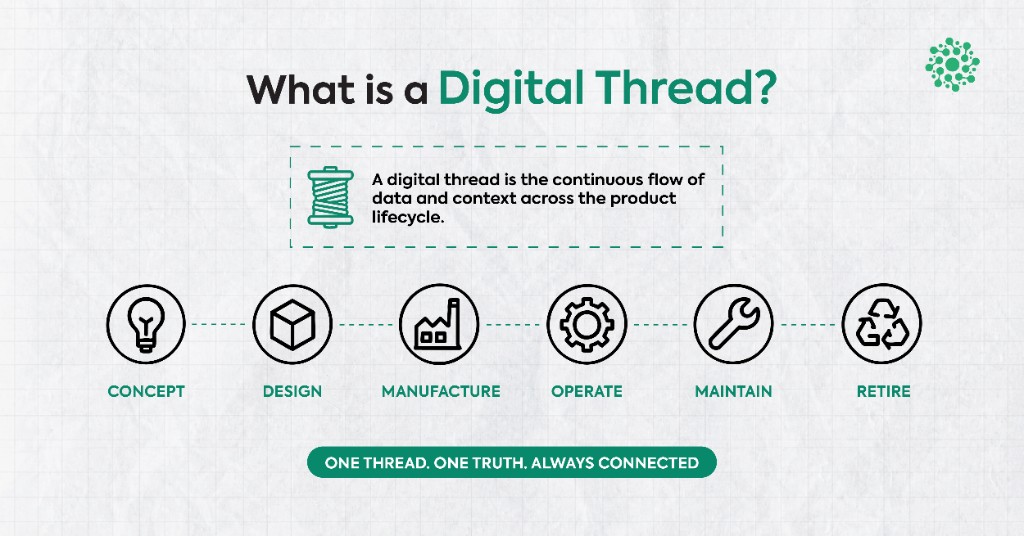
What Is a Digital Thread? Definition, Lifecycle, and Where It Breaks

Category:
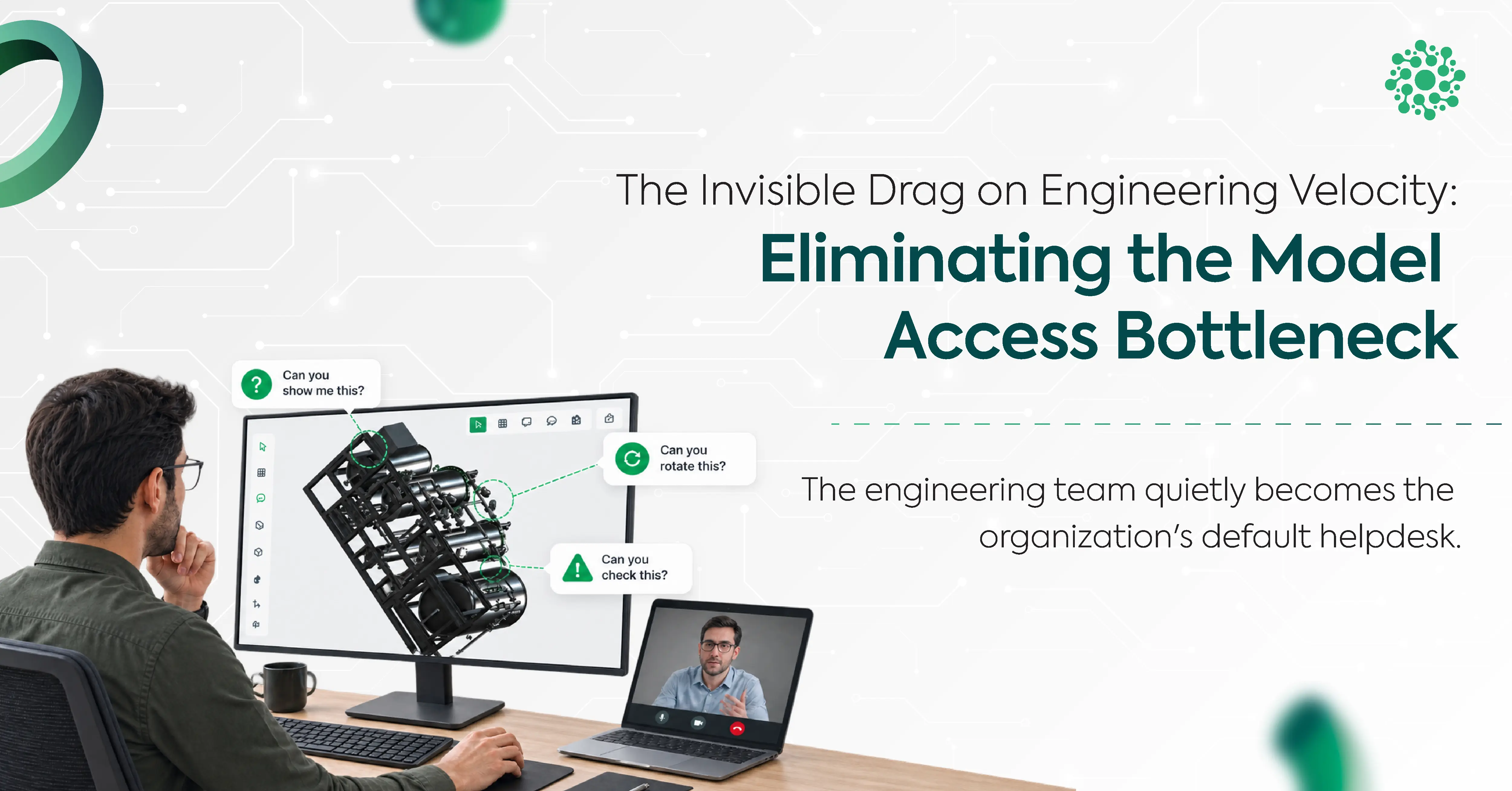
The Model Access Bottleneck: Why Non-CAD Teams Wait Days for a File
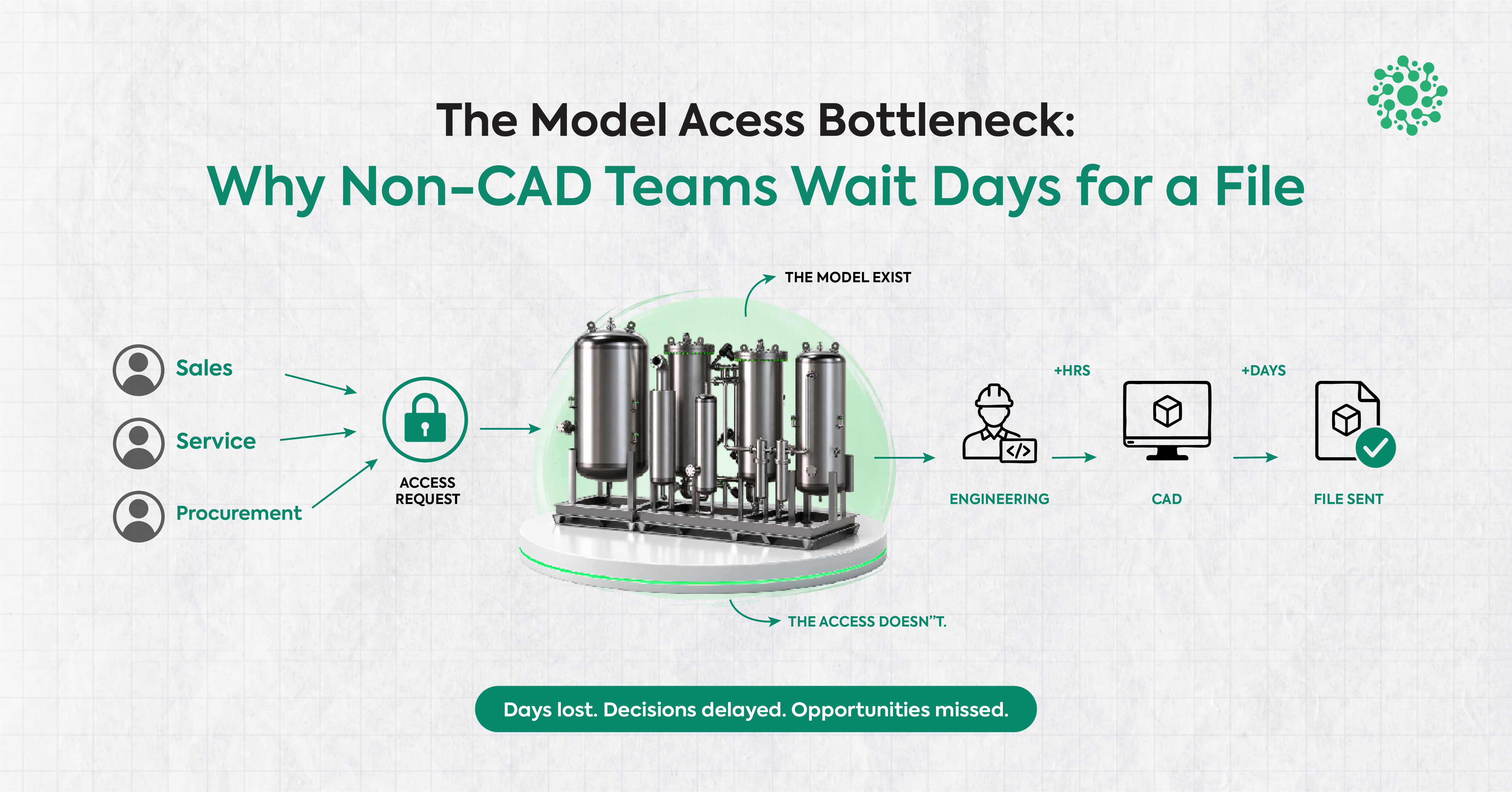
An engineer is forty minutes into a bracket revision. Slack pings: "can you send me the 3D of the new housing?" Two minutes of work, apparently. Say yes, export, move on.
That request costs a great deal more than two minutes. It also costs something entirely different depending on who sent it, which is why almost nobody prices it correctly. The cost sits in two ledgers that never appear on the same page. The second only becomes money when the delay collides with something that already has a price attached.
This post puts both ledgers on one page. We work through the arithmetic of a single access request, then follow the same two-day wait through three teams that hit three different price tags: sales, field service, and procurement.
Key Takeaways
- Every model access request burns $13 to $39 of engineer time: roughly $52,000 to $150,000 a year for a 20-engineer team.
- On the CNPC USA engagement, Optellix saved 40 hours of manual pre-processing and brought the mapping error rate to zero.
- The widely quoted "23 minutes to refocus" figure is wrong. The primary study reports 22 min 37 sec for externally interrupted work, and it measures time until the task resumes, not lost productivity (Mark, González & Harris, CHI 2005).
- Waiting is free until it hits a priced event. In 2026, 62% of manufacturers reported margin loss between quote and delivery (Tacton).
- The same delay converts three ways: margin for sales, a repeat truck roll for service, cycle time for procurement.
- Buying the requesters CAD seats is the wrong fix. The test isn't seat cost, it's whether they need to author anything.
What is the model access bottleneck?
The model access bottleneck is the delay between someone outside engineering needing to see a 3D model and actually receiving something they can open. It exists because native CAD files require a licensed authoring seat, so every request routes through an engineer who must locate, export, convert, and hand over the file by hand.
Worth separating this from the thing that usually owns the phrase. Search "CAD bottleneck" and you'll get CPU, GPU, and disk throughput — hardware pages about why a large assembly rebuilds slowly. That's a real problem and a different one. This is a permissions-and-format problem wearing a workflow costume. The engineer's workstation is fine. The file is fine. The trouble is that exactly one category of employee can open it.
Beyond the licensing, scale makes it structural. Ten people author the product; a hundred and fifty need to look at it. The buyer checking a quote. The technician planning a repair. The applications engineer on a customer call. None of them will edit geometry, and none of them have a seat. So they queue.
The request-to-file loop
The path from request to usable file isn't a line. It's a loop with a return arc, and most organizations travel it more than once per request. Drawn as a straight pipeline — ask, export, deliver — it looks like a two-minute errand. Drawn honestly, the shape explains why the wait is measured in days.
Eight stages, one return arc. The arc is what turns a two-minute errand into a two-day wait. Stage 8 either produces a usable file or sends the request back to stage 2.
- Needs geometry — sales, service, buyer
- Finds an engineer — Slack, email, ticket
- Enters the queue — informal, unranked
- Interruption — context switch
- Find the revision — PDM / PLM
- Export + convert — STEP → STL / PDF
- Transfer — size limits, IP review
- Requester opens and checks it — usable file, or the rework arc: wrong revision, wrong format, PMI stripped
Stages 1 through 3 are pure latency: the request has been made and nothing is happening. Stage 4 is where the cost starts accruing against engineering. Stages 5 through 7 are the actual work, and stage 5 is the one that quietly fails most often — finding the correct revision, not just a revision.
Why does the arc fire so often? Because the underlying data usually isn't synchronized. In 2026, only 21% of manufacturers said they automatically propagate engineering changes across their systems. That's from Tacton's 2026 State of Manufacturing, a survey of 280 manufacturing leaders across eight countries and thirteen sectors (Tacton). If changes don't propagate, "the latest file" is an educated guess. Add the format mismatches — a requester who needed dimensions and got a mesh — and the arc becomes the default path rather than the exception.
If you want the format side of that in detail, we've written up what a STEP file is and how AP242 differs from AP203.
What does one access request actually cost?
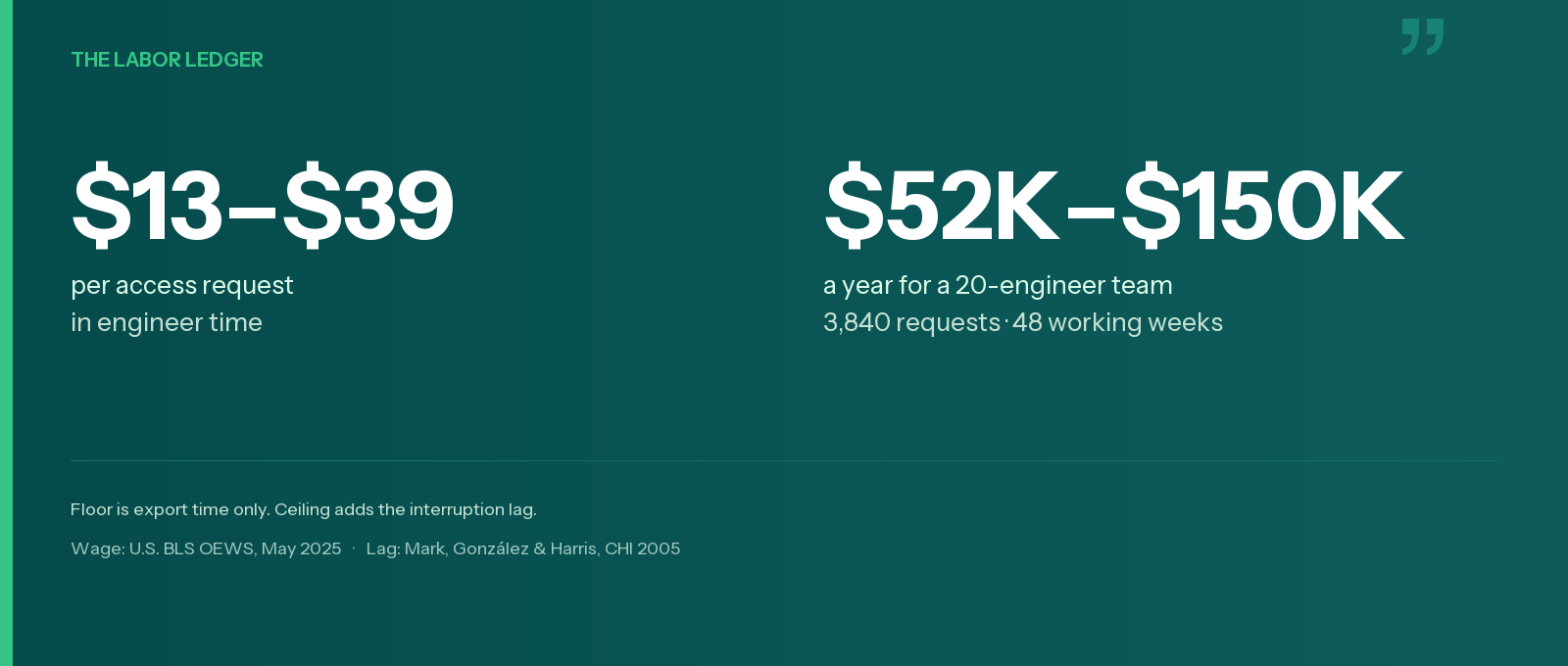
One access request costs between $13 and $39 in engineer time. The labor ledger is engineer time, and it has a floor and a ceiling. The floor is the export work alone. The ceiling adds the gap before the engineer gets back to what they were doing. We're giving you a range rather than a single number because a single number here would be dishonest, and the reason why is worth three paragraphs.
Now the correction, because this is where most published takes on interruption cost go wrong.
What we found: The figure everyone cites — "23 minutes and 15 seconds to refocus after an interruption" — does not appear in the research it's attributed to. We pulled the primary papers. Gloria Mark's 2008 CHI paper, The Cost of Interrupted Work: More Speed and Stress, is a lab experiment about working faster under pressure and contains no such number. The figure traces to a different paper: Mark, González & Harris, No Task Left Behind? Examining the Nature of Fragmented Work, CHI 2005, an observational study of 24 information workers. That paper reports an average of 25 min 26 sec before an interrupted task was resumed. For externally interrupted work specifically, it reports 22 min 37 sec (Mark, González & Harris, CHI 2005).
Two things follow. First, an access request is by definition an external interruption, so 22 min 37 sec is the right figure for this model. Second — and this matters more — the study measures elapsed time before the task was resumed, not productivity destroyed. Before returning, the observed workers passed through an average of 2.26 other work contexts. They weren't idle. They were doing other things, badly sequenced.
So charging the full 22 minutes as burned labor overstates it. Charging nothing understates it, because fragmentation is real and the paper's own informants described it as seriously detrimental. Hence the range: $13.51 is the defensible floor, $38.98 the defensible ceiling. Anyone quoting you a precise per-request figure has picked one end and hidden the choice.
Annualize it with two more assumptions — four requests per engineer per week, forty-eight working weeks. For a 20-engineer team that's 3,840 requests a year: $52,000 at the floor, $150,000 at the ceiling. Wage input: U.S. BLS OEWS, May 2025. Lag input: Mark, González & Harris, CHI 2005.
For sanity, check that against the wider picture. Tech-Clarity's research, published in 2014 and drawn from roughly 250 manufacturers, found engineers spend about a third of their time on non-value-added work and 20% working with outdated information (Tech-Clarity). More recently, a 2026 survey of over 600 U.S. manufacturing leaders found 74% still held back by reporting delays, with 65% of frontline supervisors losing up to four hours a shift to reconciling disconnected data (L2L, May 2026). Our model lands well inside that envelope, which is where it should land.
Those are industry averages. A measured Optellix number sits next to them. On the CNPC USA drill-bit engagement, automating the CAD-to-simulation handoff saved 40 hours of manual pre-processing and brought the mapping error rate to zero. That's the opposite of the four-hour-a-shift reconciliation tax L2L recorded across 600 manufacturers.
And this is still only the first ledger. It counts engineer hours and nothing else. It says nothing about the days the requester's own work sat blocked — which is the part people actually complain about, and the part that resists a single number entirely.
Three teams, three different conversions
The cycle-time ledger is the days a downstream task sits blocked, and a two-day wait carries three different prices depending on who's waiting. Delay only becomes money when it collides with an event that already has a price attached, and sales, service, and procurement each collide with a different one. This is why "what does the model access bottleneck cost us?" has no universal answer, and why every vendor that offers one is guessing.
Sales: when the wait costs margin
For sales, the delay converts into margin. In 2026, 62% of manufacturers reported at least moderate margin loss between quote and delivery. The split by data maturity is stark. Firms with siloed data hit critical margin erosion at 23%, against 12% for those working from shared systems — close to double the risk (Tacton, 2026 State of Manufacturing).
The mechanism is unglamorous. A rep needs to show a customer how a configured variant actually looks, or confirm an interface dimension before committing to a price. They can't open the model, so they either wait or guess. Waiting pushes the quote past the window. Guessing prices something that doesn't exist, and the gap shows up in delivery.
Product complexity is making the guess worse. In 2026, 67% of manufacturers described their products as very or extremely complex, a twenty-point jump in a single year. In the same survey, 43% named customization as their top quoting challenge, up from 36% in 2022 (Tacton). The screenshot workaround degrades exactly as configurability rises. A static image of one variant tells a customer almost nothing about theirs.
Which raises an obvious question: if the rep can't see the model, what are they sending the customer instead? Usually a PDF, which is its own well-documented failure mode.
Field service: when the wait costs a second truck roll
For service, the delay converts into dispatches, and dispatches have a hard price. Aberdeen's long-cited field service research put the average first-time fix rate at 75% in its 2013 survey. It named the leading cause of repeat visits as lacking the proper parts on site, at 51% of cases, well ahead of insufficient training at 25% (via Fieldpoint). A technician who couldn't see the assembly before rolling is guessing at which part to carry.
Then comes the collision. Aberdeen put a single service call at $200 to $300. The Technology & Services Industry Association puts the fully loaded figure closer to $1,000 once labor, travel time, vehicle costs, tooling amortization, and back-office allocation are all counted (via AEX). The spread isn't sloppiness — it's a genuine disagreement about what belongs in the number. The lower figure counts the visit; the higher one counts the visit and everything required to make it possible.
Either way, the arithmetic lands in the same place. One avoided repeat visit, at $200, covers roughly fifteen access requests at the ceiling rate. At $1,000, it covers about twenty-six. The service organization doesn't need the model access problem solved cheaply. It needs it solved at all.
Worth noting the second-order effect too: a technician who requests a model mid-job isn't in the queue for two days. They're on site, and the request fails in minutes rather than days. What tends to happen next is covered in our piece on what happens to 3D models once they leave engineering.
Procurement: when the wait costs cycle time and rework
For procurement, the delay converts into cycle time — and then into rework, which is worse. In 2026, Campfire Interactive reported that most Tier 1 and Tier 2 automotive suppliers take two to three weeks to respond to an OEM RFQ. That number "has barely moved in a decade," even as OEMs shortened award timelines and pushed more cost risk down the chain (Campfire Interactive, July 2026). Aggressive programmes sometimes allow a week.
Against that clock, a two-day wait for geometry isn't a rounding error. It's ten to twenty percent of the response window spent waiting for a file that already exists.
Even so, the rework is the expensive half. Recall that only 21% of manufacturers automatically propagate engineering changes (Tacton, 2026). A buyer working from an export that arrived last Thursday may be sourcing against a superseded revision, and nothing in the file tells them so. The quote comes back priced for geometry that changed. Whether that surfaces at PO, at first article, or at the dock, it surfaces.
The upside of fixing the data path is measurable. Procurement organizations that connect their systems achieve 24% shorter sourcing cycles and 58% shorter requisition-to-PO cycles, according to The Hackett Group (via Elisa IndustrIQ). Access to current geometry is one strand of that, not the whole of it — but it's the strand engineering controls. The broader breakdown between engineering and the teams facing outward is something we've written about separately.
Why is a CAD seat the wrong fix?
Most teams price the fix as licences, and correctly reject it. SOLIDWORKS subscriptions run roughly $2,820 to $4,195 per seat per year depending on package and licence type (GoEngineer). Nobody is buying that for a procurement analyst who needs to look at a bracket twice a month.
But seat cost is still the wrong test. The right test is whether the requester needs to author anything — and almost none of them do. Viewing, measuring, sectioning, and marking up are a different capability from modelling. They need a viewer, not a geometry kernel. The licence is only the visible cost anyway; the training and administration behind a full CAD system are the ones that persist.
The workarounds fail for reasons the loop diagram already explains. Screenshots carry no dimensions and no revision, so stage 8 rejects them. 2D PDFs drop the geometry that made the request necessary. Screen-shares work, but they're synchronous — they solve the requester's problem by re-importing the engineer's interruption, which is the thing you were trying to remove. In our own delivery work at Optellix, the requests that resolve cleanly share one trait: the non-CAD role never has to ask. They open the current model themselves, in a browser, against a source that's already correct. That's what Xviewr exists to do, and it's the same argument we make in making 3D accessible across the organization.
What this model doesn't cover
Three limitations worth stating plainly, because a cost model you can't argue with isn't a cost model.
- The touch time and request frequency are assumptions, not measurements. We haven't surveyed how long a typical export takes across a population of engineering teams. Twelve minutes and four requests a week are plausible defaults, nothing more. Your PDM maturity moves both substantially.
- The interruption research is twenty years old and wasn't about engineers. The CHI 2005 study observed 24 information workers in a general office setting. We use it because it's the primary source behind a number the whole industry quotes. It's also honest about its own variance: the standard deviation on that 22 min 37 sec is larger than the mean.
- The cycle-time ledger deliberately has no total. We've shown three conversion mechanics rather than one blended figure, because blending them produces a number that's precise and meaningless. If your organization is service-heavy, weight the truck rolls. If it's quote-driven, weight the margin.
What the model does support is a decision. If your floor figure alone is uncomfortable, the payback question is already answered, and refining the assumptions won't change it.
Frequently Asked Questions
Why can't sales or procurement open CAD files?
Native CAD files require a licensed authoring seat, and the formats are proprietary and heavy. A SOLIDWORKS subscription runs roughly $2,820 to $4,195 per seat per year (GoEngineer), which no organization buys for occasional viewing. So access routes through an engineer instead.
How much does one CAD access request cost?
Between $13.51 and $38.98 in engineer time under our stated assumptions. The floor counts twelve minutes of export work at a loaded rate derived from the U.S. BLS median mechanical engineer wage of $104,110 (OEWS, May 2025). The ceiling adds the 22 min 37 sec resumption lag from the CHI 2005 interruption study.
Is it really 23 minutes to refocus after an interruption?
No. That figure is widely repeated but doesn't appear in the paper it's credited to. The primary source is Mark, González & Harris at CHI 2005. It reports 25 min 26 sec average time before an interrupted task was resumed, and 22 min 37 sec for externally interrupted work. It measures elapsed time, not lost productivity.
How do you give non-engineers access to 3D models without a CAD seat?
Serve a lightweight, neutral copy of the model through a browser-based viewer, so the requester opens it themselves without an install or a licence. That's what browser-based CAD viewers do, and it removes stages 2 through 7 of the request loop entirely.
Is a screenshot or 2D PDF good enough?
Rarely. Both drop dimensions, revision context, and any product manufacturing information attached to the model. That's precisely what triggers the rework arc: the requester receives a file, can't answer their actual question with it, and returns to the queue. The second request costs the same as the first.
The point of the arithmetic
None of this argues that engineers should stop helping colleagues. It argues that a request routed through a person gets priced twice. Once in engineer hours, and once in whatever the waiting team was trying to finish.
- The labor ledger is real, chargeable, and lands between $52,000 and $150,000 a year for a 20-engineer team under our assumptions.
- The proof that the handoff can be taken off the engineer is not theoretical: CNPC USA saved 40 hours of manual pre-processing and drove mapping errors to zero.
- The cycle-time ledger has no single figure. It converts into margin for sales, into repeat dispatches for service, into cycle time and stale-geometry rework for procurement.
- The loop has a return arc, and the arc is what turns two minutes into two days.
- Seat cost is the wrong unit of comparison. Authoring need is the right one.
Run the model with your own inputs — your wage basis, your request volume, your export reality. If the floor figure alone is uncomfortable, the answer isn't more CAD seats. It's giving the people who only need to look a way to look.
.webp)
Never miss
Oops! Something went wrong while submitting the form.
Looking for Something Similar?
We have built everything from Creo plugins to AI-based VR walkthroughs. If your challenge feels like one of these — or somewhere in between — we would love to hear about it.
Feel free to share your details!
Oops! Something went wrong while submitting the form.