
What Is a Digital Thread? Definition, Lifecycle, and Where It Breaks

Category:
What Is a STEP File? STP vs STEP and AP203 vs AP214 vs AP242, Explained

What Is a STEP File? STP vs STEP and AP203 vs AP214 vs AP242, Explained
A supplier emails you a part. The file ends in .stp, you double-click it, and nothing happens. No preview, no app, just a file your computer doesn't recognize. If you've ever been handed a 3D model you couldn't open, you've already met the STEP file.
STEP is the closest thing engineering has to a universal language for 3D. It's how a model travels from one CAD system to another, and how it reaches the people, buyers, machinists, inspectors, who need to see a part but don't run CAD. The catch comes one step earlier, when someone exports the file and their tool asks: AP203, AP214, or AP242? Most people guess. That guess quietly decides what data survives the trip to whoever opens the file next. This guide covers what a STEP file is, why STP and STEP are the same thing, how the three versions compare, and how to view one without a CAD seat. For the bigger picture on opening these files in a browser, start with our pillar on the browser-based CAD viewer.
Key Takeaways
- A STEP file is a neutral, text-based 3D CAD format defined by ISO 10303 that exchanges models between CAD systems like Creo, SolidWorks, NX, and CATIA.
- .stp and .step are the same format. Only the extension differs, a holdover from older 3-character file naming.
- The Application Protocols differ by what extra data they carry: AP203 adds configuration management, AP214 adds color and layers, AP242 adds semantic PMI and GD&T.
- AP242, published in 2014, is the current International Standard. ISO withdrew AP203 and AP214 when AP242 superseded them (Capvidia, 2014).
- Rule of thumb: export the most capable AP your CAD tool supports, starting with AP242.
What is a STEP file?
A STEP file is a neutral, text-based 3D CAD format defined by the international standard ISO 10303. STEP stands for STandard for the Exchange of Product model data, first published in 1994. It carries a model's geometry and structure between different CAD systems without exposing the proprietary, editable source file (STEP Tools, ISO 10303).
The word that matters is neutral. A SolidWorks part lives in a .sldprt file that only SolidWorks fully understands. Export it to STEP and any major CAD tool, Creo, NX, CATIA, Inventor, can read the geometry. The format is the common ground.
STEP files are also plain text. The geometry is encoded in a human-readable structure (ISO 10303-21), which is why a STEP file is larger than a binary equivalent but survives transfer across systems cleanly. To open one without buying CAD, you reach for a STEP file viewer, covered in our guide to the browser-based CAD viewer.
So a STEP file answers a narrow question: how do you hand a precise 3D model to someone who doesn't run the tool that made it? It also sits inside the broader practice of MCAD, mechanical design data. Where STEP fits among other 3D formats, JT, glTF, STL, is a separate comparison, covered in how STEP compares to JT, glTF, and STL.
Is a STP file the same as a STEP file?
Yes. A .stp file and a .step file are the same format, with the same internal structure defined by ISO 10303-21. The only difference is the extension. .stp is the legacy three-character form, a holdover from older operating systems that capped extensions at three letters; .step is the modern spelling (Library of Congress, FDD000448).
No conversion is needed between them. If a supplier sends you a .stp and your system expects .step, you can often just rename it, though most software opens either without complaint.
The confusion is purely cosmetic. Both extensions point to identical content, so there is no quality or capability difference between a file named .stp and one named .step.
What's the difference between AP203, AP214, and AP242?
The three Application Protocols share the same core, geometry, topology, and assembly structure, and differ in what extra data they carry. AP203 adds configuration management, AP214 adds color and layers, and AP242 adds semantic product manufacturing information (PMI) such as GD&T (Capvidia, 2014).
Think of them as the same model exported at three levels of richness. The geometry is identical. What changes is how much engineering intent travels with it.
- AP203 ("Configuration Controlled 3D Design") targets mechanical parts and assemblies. It carries geometry and configuration data but no color or PMI. It is the lean option for basic shape exchange.
- AP214 ("Core Data for Automotive Design") extends AP203 and adds color and layer management. It became common in automotive workflows where visual attributes matter.
- AP242 ("Managed Model-Based 3D Engineering") merged AP203 and AP214 in 2014 and added semantic PMI: tolerances, surface finish, and datums tied to the geometry rather than drawn as flat notes.
Which STEP version should you export?
Export the most capable Application Protocol your CAD tool supports, starting with AP242, then AP214, then AP203. AP242 carries the most engineering intent, so it loses the least on the way out. The fallbacks exist for older systems that can't read the newer protocol.
But the real test is the receiver, not the export menu. What does the person opening the file actually need to see? The decision comes down to three questions:
- Do they need tolerances and PMI? Export AP242. Only AP242 carries semantic GD&T that an inspector or reviewer can read off the model.
- Do they need color or layers, but not PMI? AP214 is enough.
- Are they on a legacy system that only reads basic geometry? AP203 is the safe fallback.
AP203 1994 geometry + config mgmt AP214 + color + layers AP242 2014 · current + semantic PMI merges 203 + 214 Source: ISO 10303; Capvidia, 2014. Each protocol adds to the one before it. The STEP Application Protocols, by what each one adds. AP242 is the current ISO standard. Source: ISO 10303; Capvidia, 2014. The pattern is simple: pick the AP by what the model has to prove on the other end, then drop down only if the receiver's software forces you to.
AP203 and AP214 are withdrawn standards
AP203 and AP214 are no longer current International Standards. ISO withdrew both, lifecycle stage 95.99, when AP242 was published in 2014 and absorbed their capabilities into a single protocol (ISO 10303-242:2014). AP242 is the standard ISO now maintains.
Withdrawn does not mean unreadable. Almost every CAD tool still exports and imports AP203 and AP214, and millions of legacy files use them. The status is about which standard ISO actively develops, not whether the files work.
So why do CAD export menus still list all three? Compatibility. A receiver on older software may only accept AP203 or AP214, so the fallbacks remain useful. Treat them as supported legacy options, with AP242 as the default for anything new.
What software opens a STEP file?
Any major mechanical CAD tool imports STEP, including Creo, SolidWorks, NX, CATIA, Inventor, and Fusion 360. But you don't need any of them just to look at the model. A browser-based 3D viewer opens STEP and STP files with no install, and many parse the file locally so it never uploads anywhere (Innerscene, 2026).
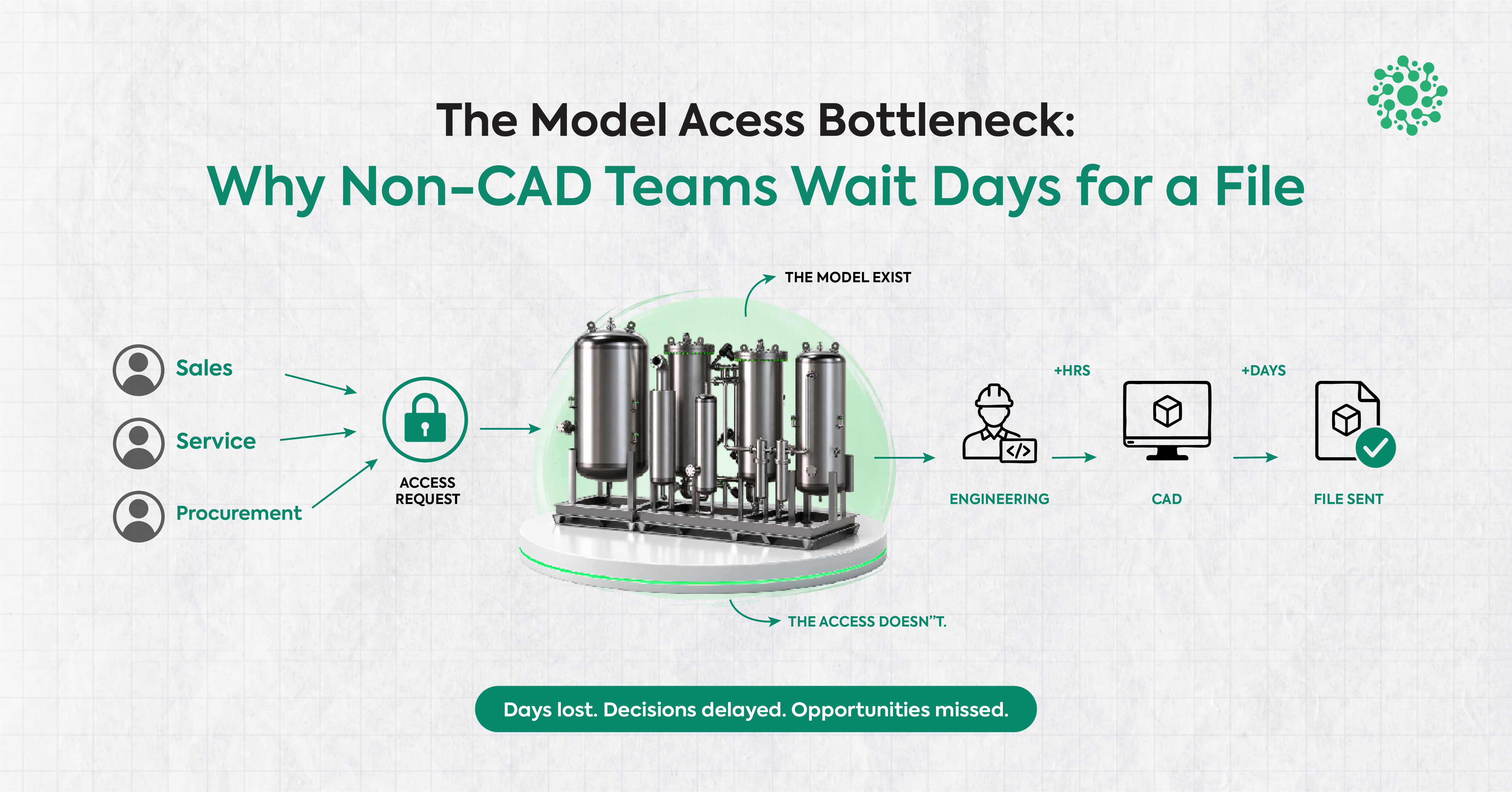
This distinction matters because most people who receive a STEP file aren't engineers. They're in procurement, manufacturing, or quality, and a CAD seat costs thousands of dollars they have no reason to spend. A STEP file viewer closes that gap. It also keeps design reviews moving, because a reviewer can open the model, measure it, and leave annotation or markups without owning the CAD tool that made it.
For the practical walkthrough, see how to open a STEP file. For the broader case for license-free access, read why engineering teams need a browser-based 3D viewer.
What a STEP file contains, and what it loses
A STEP file carries exact B-Rep geometry, assembly structure, and, in AP242, semantic PMI. What it does not carry is the feature history and parametric intelligence of the native model. Open a STEP import in your CAD tool and you get solid geometry, not the editable feature tree that built it.
That trade-off is the point of a neutral format. The receiver gets a precise, system-independent model they can measure, section, and review, without your proprietary design recipe. The geometry is exact; the "how it was modeled" is left behind.
For inspection and design reviews, the PMI question is the one that bites. If the model was exported as AP203, the tolerances and GD&T simply aren't in the file, no viewer can show data that was never written. That is why the export choice and the what 3D model metadata and PMI are question are tightly linked. The same model often feeds a digital mockup, where reviewers check fit and clearance long before anything is cut.
Frequently asked questions
Is a STP file the same as a STEP file?
Yes. A .stp file and a .step file are identical in format, both defined by ISO 10303-21. The only difference is the extension: .stp is the legacy three-character form, .step is the modern spelling. No conversion is required, and most software opens either one.
Which STEP version should I use?
Export the most capable Application Protocol your CAD tool supports, starting with AP242, then AP214, then AP203. AP242, published in 2014, carries the most engineering intent, including semantic PMI. Drop to AP214 or AP203 only if the receiving software can't read the newer protocol.
Does a STEP file contain color or PMI?
It depends on the Application Protocol. AP203 carries geometry and configuration management but no color or PMI. AP214 adds color and layers. AP242 adds semantic PMI, including GD&T and tolerances tied to the geometry. If you need PMI to survive export, you must use AP242.
Is STEP a 3D or 2D format?
STEP is primarily a 3D format, carrying solid B-Rep geometry and assembly structure. The broader ISO 10303 standard covers many kinds of product data, but in everyday CAD use, a STEP file means a 3D model exchanged between systems, not a 2D drawing.
How do I open a STEP file without CAD software?
Use a browser-based CAD viewer. These open STEP and STP files with no install, and many parse the file locally so it never uploads (Innerscene, 2026). It's the standard way for non-engineers to view, measure, and annotate a model without a CAD license.
The bottom line
A STEP file is the neutral, ISO 10303 format that lets a 3D model travel between CAD systems without handing over the editable source. The version you export, AP203, AP214, or AP242, decides how much engineering intent goes with it.
Key points to carry forward:
- STEP is defined by ISO 10303 and is text-based and system-independent.
- .stp and .step are the same format; only the extension differs.
- AP203 adds config management, AP214 adds color, AP242 adds semantic PMI.
- AP242 (2014) is the current standard; AP203 and AP214 are withdrawn but still supported.
- Export the most capable AP the receiver can read, starting with AP242.
Got a STEP file and no CAD seat? The fix is a browser-based 3D viewer. Here's how to open and review one in a browser, no install required, so the people who only need to look at a part aren't blocked by a license they'll never use.
.webp)

Never miss
Oops! Something went wrong while submitting the form.
Looking for Something Similar?
We have built everything from Creo plugins to AI-based VR walkthroughs. If your challenge feels like one of these — or somewhere in between — we would love to hear about it.
Feel free to share your details!
Oops! Something went wrong while submitting the form.