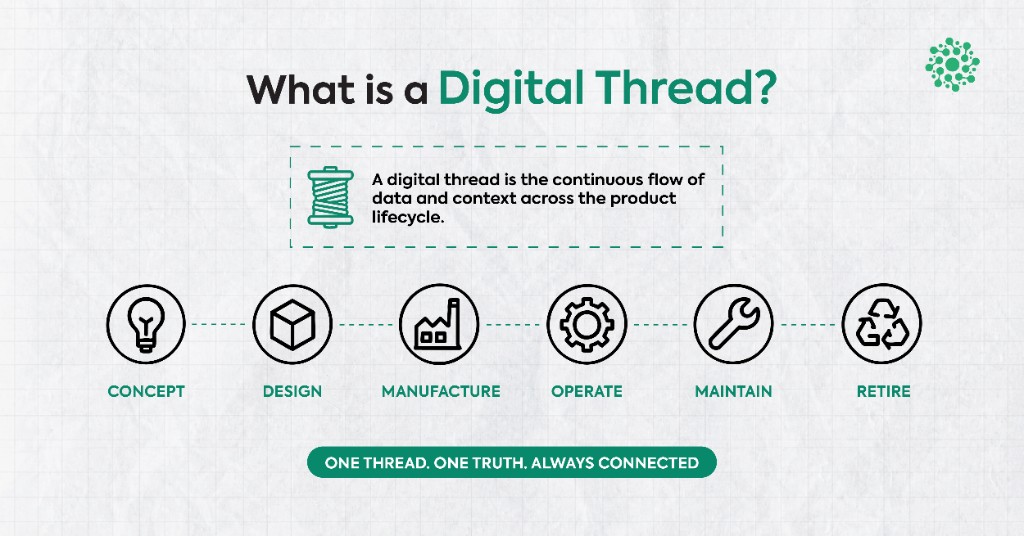
What Is a Digital Thread? Definition, Lifecycle, and Where It Breaks

Category:
Why the Digital Thread Breaks Between Customer Facing Teams and Engineering
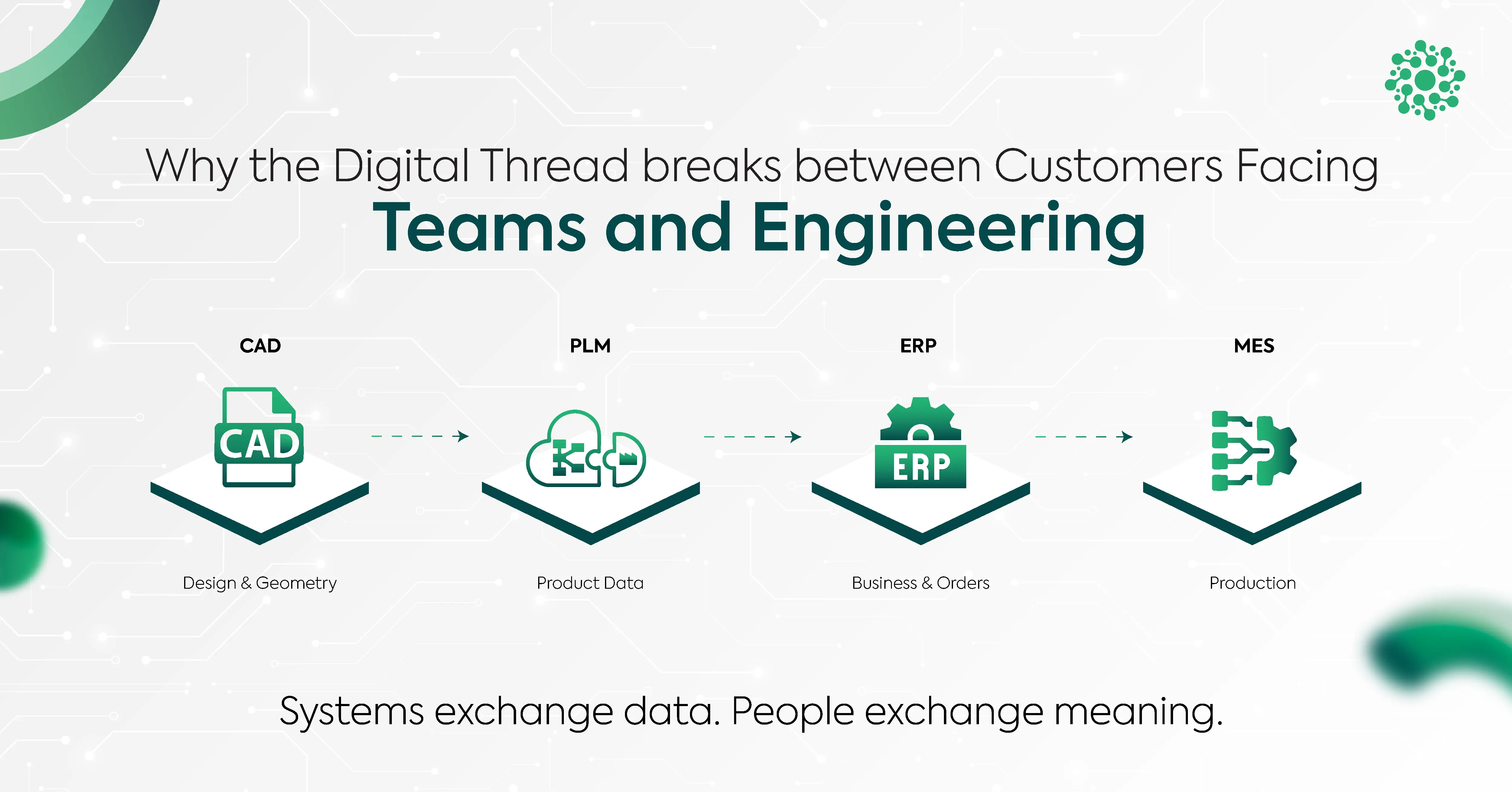
Automotive manufacturers have integrated CAD, PLM, ERP, and MES more deeply than ever, yet engineering teams still lose hours answering routine questions that should have been resolved in minutes.
The digital thread doesn't break because enterprise systems fail to exchange data. It breaks because people struggle to exchange engineering context.
This article explores a single question: why does engineering context break down even when enterprise systems are fully connected?
The Real Bottleneck
Modern automotive enterprises have largely solved system connectivity. CAD publishes geometry to PLM. PLM synchronizes bill of materials with ERP. ERP generates work orders for MES, and MES feeds production data back into the digital thread.
From a systems perspective, the data moves exactly as intended. Yet decisions often don't.
The reason is subtle but fundamental. Systems exchange data. People exchange meaning. And engineering decisions depend on meaning, not data alone.
Consider a common scenario. A sales engineer needs to confirm whether a revised battery tray fits a specific EV variant. That question doesn't move through APIs or system integrations. It moves through emails, screenshots, presentations, and meetings. With every handoff, a little more engineering context disappears.
By the time the request reaches engineering, the data may still be connected, but the meaning behind it often is not.
What Engineering Context Actually Means
Engineering context is the complete set of information that allows a stakeholder to understand not just what a part is, but why it exists in its current form and how it relates to everything around it.
Engineering context includes:
1. 3D Geometry & Spatial Relationships
The complete geometry of an assembly, including how individual parts fit, interact, and relate to one another in three-dimensional space.
2. Product Configuration & Variants
Configuration-specific information such as long wheelbase versus standard models, left-hand drive versus right-hand drive, or region-specific product requirements.
3. Design Intent
The engineering rationale behind a design, including why a feature was created, why a tolerance was specified, or why a particular material or manufacturing approach was selected.
4. BOM Structure & Part Relationships
Parent-child relationships, assembly hierarchies, and component dependencies that define how products are organized and built.
5. Revision & Change Status
The current engineering revision of a component, including whether it reflects the latest design change or an earlier released version.
6. Manufacturing Constraints
Production considerations such as tooling limitations, assembly sequence requirements, inspection criteria, and other factors that influence manufacturability.
7. Engineering Annotations
Notes, dimensions, measurements, markups, and callouts that capture technical observations or clarify engineering decisions.
8. Supporting Engineering Documentation
Related resources such as test reports, validation results, compliance documents, supplier specifications, and other reference materials that provide additional context.
When all of these elements move together, engineering decisions become faster, clearer, and more accurate. When even one layer of context is lost, teams spend valuable time reconstructing information instead of making decisions.
Why Context Is Lost at Every Handoff
Context loss is not accidental; it is structural. Every translation step removes engineering meaning.
Every time information moves from one format, system, or stakeholder to another, a portion of its original meaning disappears. What begins as a complete engineering model gradually becomes a simplified representation, leaving downstream teams to reconstruct the missing context.
A typical design question moves through an organization like this:
- Native CAD: Contains the complete design, including geometry, parameters, constraints, design intent, and feature history.
- Neutral CAD: Formats such as STEP or IGES preserve geometry for interoperability but omit parametric history and parts of the original engineering metadata.
- 2D Drawings: Capture selected views, dimensions, and annotations, but cannot fully represent spatial relationships or internal assembly details.
- Screenshots: Provide a static visual reference, yet cannot be rotated, measured, sectioned, or explored from different perspectives.
- Emails: Add written explanations, but interpretation varies between readers and important visual context is often missing.
- Phone Calls: Enable quick discussions, but leave no persistent visual record for future reference or collaboration.
None of these formats are inherently flawed. The challenge is that each translation removes another layer of engineering context. By the time a question reaches engineering, teams often spend more time reconstructing the original problem than resolving it. This is why integrated enterprise systems can still produce slow engineering decisions.
Automotive-Specific Pressures That Amplify Context Loss
Every manufacturing industry depends on accurate engineering communication, but automotive makes the challenge significantly more complex.
- Vehicle Variants & Platform Sharing: A single component may exist across dozens of vehicle configurations, markets, or platform derivatives. Even small differences between variants can change the engineering answer.
- Engineering Change Orders: Design updates rarely affect one component in isolation. A routing change to a wiring harness, for example, can influence tooling, assembly sequencing, supplier deliverables, and production planning.
- Multi-Tier Supplier Collaboration: Engineering data moves across OEMs and suppliers that often use different CAD platforms, processes, and review workflows, increasing the likelihood of context loss.
- Fitment Validation: Engineers must evaluate how chassis components, battery packs, structural members, and interior modules interact within the complete assembly. Static documents rarely provide enough context for confident validation.
- Assembly Sequencing: Even a minor design revision can affect how products are assembled on the production line. Without complete engineering context, manufacturing issues may remain hidden until pilot builds or production validation.
As products become more configurable and supply chains more interconnected, preserving engineering context becomes increasingly important. The more stakeholders involved in a decision, the more engineering meaning must travel with every handoff.
A Realistic Workflow
Consider a complete end-to-end scenario that illustrates the problem and the path to a better workflow.
A customer asks whether a revised battery tray is compatible with a specific EV variant that uses a long wheelbase and a particular battery chemistry.
The sales team needs a quick, accurate answer to confirm pricing and delivery. Instead of relying on emails or static screenshots, they open the assembly in a browser-based engineering viewer, capture a contextual snapshot, annotate the area of concern, and include the relevant variant and BOM information.
Engineering immediately reviews the shared context. They inspect the assembly, verify clearances, and respond directly against the same visual reference. Manufacturing then evaluates whether the revision affects tooling or assembly sequencing, while suppliers receive the same revision state and supporting context needed to update their own processes.
Within hours, the customer receives a confident answer backed by a shared understanding of the design rather than multiple rounds of clarification.
This isn't simply a faster way to communicate. It's a better way to make engineering decisions because the context remains intact throughout the entire workflow.
The Hidden Cost of Lost Context
Most organizations measure delays by how long communication takes. A more meaningful metric is decision latency: the time required for a stakeholder to make a confident engineering decision.
Poor engineering context doesn't just slow communication; it slows decision making. Communication is merely a symptom. Decision latency is the real business problem.
As engineering context becomes fragmented across handoffs, the impact extends far beyond a few extra emails. Teams spend more time clarifying requests, engineers repeatedly open the same assemblies to answer similar questions, and suppliers wait longer for accurate information before responding to RFQs.
Customer responses slow down, unnecessary CAD reviews become routine, and stakeholders struggle to reach decisions because they are no longer working from the same engineering context.
These costs rarely appear as a line item in a budget. Instead, they surface as missed deadlines, reduced engineering capacity, longer sales cycles, and frustrated customers.
Why Traditional Communication Tools Fall Short
Most organizations already rely on a combination of communication tools, and each serves an important purpose. The challenge is that none of them preserves complete engineering context throughout the decision-making process.
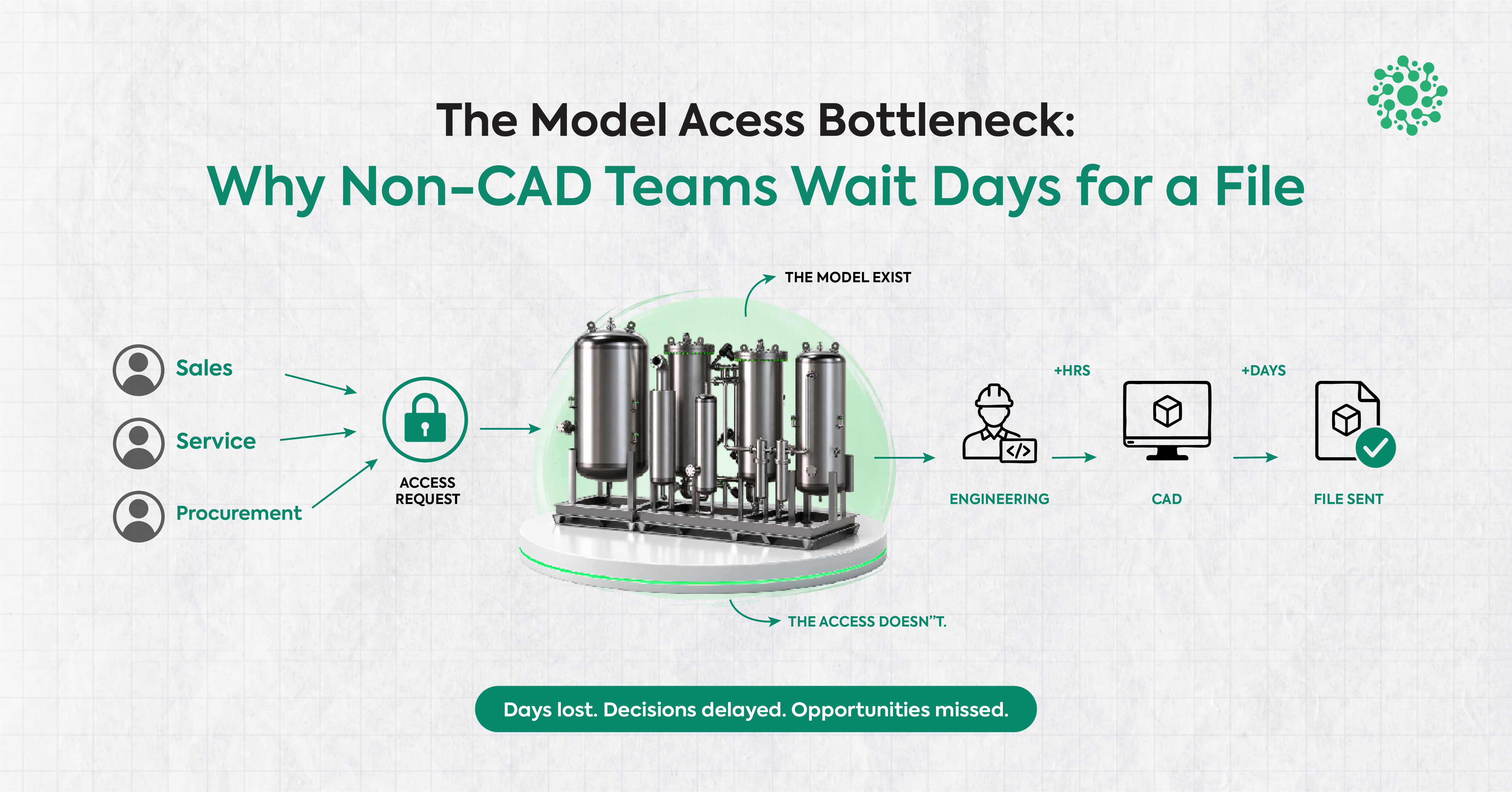
Emails capture conversations but not interactive 3D context. Screenshots and photographs provide a visual reference, yet they cannot be rotated, measured, sectioned, or explored further. PDFs and 2D drawings document dimensions and annotations, but they cannot fully represent complex assembly relationships. Native CAD contains the complete model and design intent, although it requires specialized software, hardware, and expertise that most customer-facing teams do not have.
The problem isn't a lack of tools. It's the absence of a shared visual layer that allows every stakeholder to understand the same engineering context without relying on CAD files.
What Better Engineering Collaboration Looks Like
Imagine a workflow where anyone involved in a customer request can:
- Open the relevant assembly without installing CAD.
- Isolate the exact component or subassembly in question.
- Capture a clear visual reference that preserves 3D context, variant information, and BOM relationships.
- Annotate the area in question with labels, measurements, or comments that convey engineering intent.
- Share structured context that includes revision state, associated documents, and manufacturing constraints.
- Receive technical feedback quickly because the engineer sees exactly what is being asked and why.
This is not about replacing CAD or PLM systems. It is about adding a lightweight layer that lets 3D geometry and engineering meaning travel across the organization without friction.
When downstream teams can participate directly in 3D, discussions become more concrete, more aligned, and less interpretive. Decisions accelerate because context is preserved.
Closing the Loop with Visual Engineering Collaboration
Browser-based engineering visualization helps preserve engineering context throughout the entire decision process. This is precisely where Optellix bridges the gap.
Optellix provides the infrastructure that enables true visual engineering collaboration. By streaming CAD models into secure, browser-based environments, Optellix allows sales, procurement, manufacturing, and customer-facing teams to inspect geometry, verify variants, and share interactive 3D feedback without needing local CAD licenses or deep technical expertise.
Returning to the battery tray example, instead of describing the issue in an email or attaching a static screenshot, customer-facing teams use Optellix to share the exact location, configuration, and supporting engineering information within a single interactive visual reference.
Engineering immediately understands the question because the required context already exists.
Manufacturing reviews the same information to assess any impact on tooling or assembly sequencing, while suppliers reference the identical engineering view to update their own processes with confidence.
The outcome is not simply faster communication. It is faster, more consistent engineering decisions because every stakeholder works from a single source of truth.
The Next Stage of the Digital Thread
Data keeps enterprise systems synchronized. Engineering context keeps people aligned.
The next stage of the digital thread is not about connecting more software platforms. It is about ensuring engineering context remains intact wherever decisions are made.
As automotive products become increasingly configurable and collaboration extends across OEMs, suppliers, manufacturing, quality, and customer-facing teams, preserving engineering context becomes just as important as exchanging engineering data.
Engineers will continue working in CAD, PLM, and simulation environments, while downstream teams need secure, browser-based access to the information required to understand, review, and discuss engineering decisions.
Digital transformation is not complete when systems are connected. It is complete when every stakeholder, regardless of technical expertise, can participate in engineering decisions with clarity, confidence, and shared context.
Frequently Asked Questions
Why do integrated PLM and ERP systems still fail to reduce engineering clarification cycles?
They connect data, not context. A question still has to travel through emails, screenshots, and PDFs to reach engineering, and context breaks down at every hop.
What's the difference between engineering data and engineering context?
Data is what something is. Context is why it's that way. You need both to make a real decision; data alone just raises more questions.
How can a manufacturer tell if their digital thread is breaking?
Look for repeated clarification requests, duplicate CAD reviews, stalled RFQs, and teams defaulting to screenshots. These are all signs that context isn't making it through.
Why do vehicle variants make this worse in automotive?
Every variant changes the geometry. Before anyone can answer a question, they first have to confirm which configuration they're even talking about.
Can non-CAD users take part in engineering reviews?
Yes. Browser-based viewers let anyone open, inspect, and annotate an assembly with no install, no license, and no CAD experience required.
Where does Optellix fit alongside existing CAD and PLM tools?
On top, not instead of. It streams CAD models into the browser so teams can view and annotate without touching the master files or your core systems.
.webp)
Never miss
Oops! Something went wrong while submitting the form.
Looking for Something Similar?
We have built everything from Creo plugins to AI-based VR walkthroughs. If your challenge feels like one of these — or somewhere in between — we would love to hear about it.
Feel free to share your details!
Oops! Something went wrong while submitting the form.