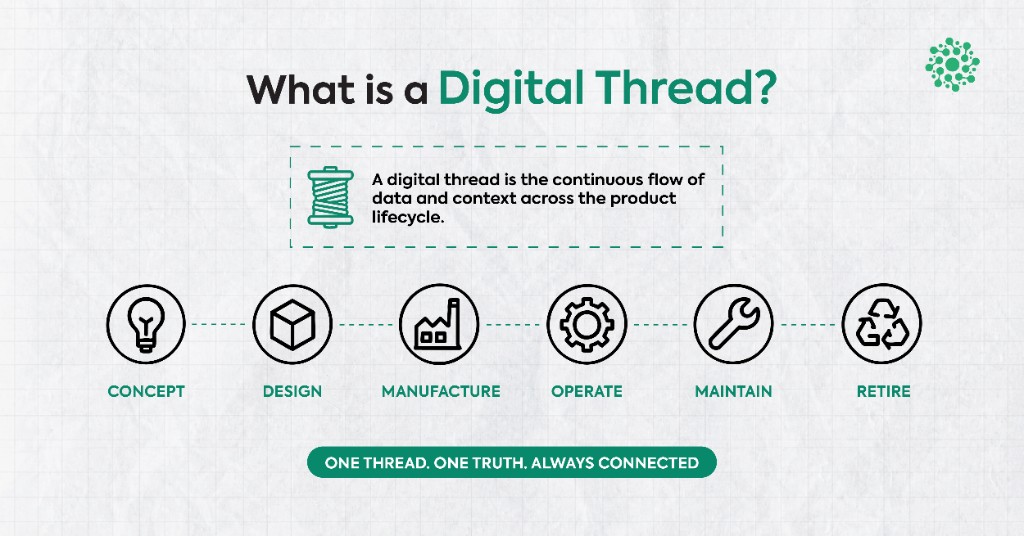
What Is a Digital Thread? Definition, Lifecycle, and Where It Breaks

Category:
AI Solved 3D Generation. Now Engineering Has a Delivery Problem
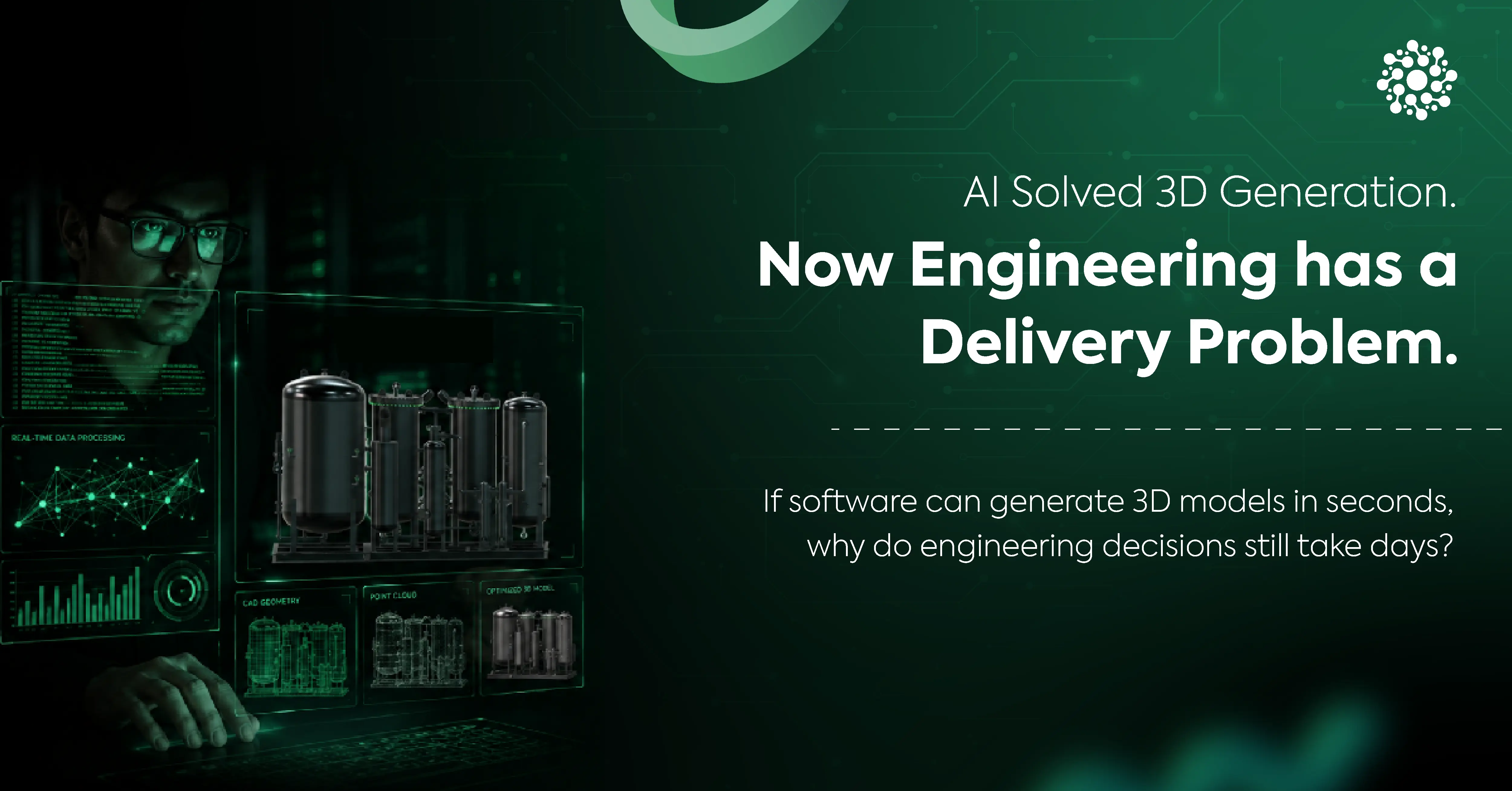
For decades, creating high-quality 3D models and CAD assemblies required specialized expertise, powerful workstation hardware, and significant manual effort. Producing detailed architectural concepts, digital twins, or complex mechanical assemblies often took hours, or even days. Today, generative AI and modern algorithmic tools can produce 3D visual geometry and conceptual models in a fraction of that time.
At first glance, it seems like the engineering speed bottleneck has been solved. In reality, it has simply shifted.
Generating 3D geometry is no longer the slowest part of the product lifecycle. Delivering that data to the people who need it to make decisions remains a massive enterprise challenge. If software can generate 3D models in seconds, why do engineering decisions still take days?
In this article, we explore the reality of modern engineering delivery, AI-driven CAD workflows, and the infrastructure required to turn generated 3D models into business-ready engineering assets.
AI Didn't Eliminate the Bottleneck
Major technological advances rarely remove constraints entirely: they relocate them.
Before the rise of AI, model creation dominated engineering timelines. Building detailed CAD geometry or digital twins required skilled engineers, specialized software, and intensive labor. Because model generation consumed the vast majority of team capacity, delivery and cross-functional distribution received far less structural attention.
Today, the situation has changed. Generative AI and automated design algorithms can synthesize 3D geometry, propose design variations, and construct assemblies in seconds. However, those raw models, often outputted as dense polygonal meshes or unoptimized geometry, must still be prepared before they can support real engineering work and manufacturing decisions.
The new bottleneck is engineering delivery.
Engineering delivery is not simply about moving files from one location to another. It is the process of preparing, optimizing, and distributing engineering models so they can be securely accessed, visualized, and used for collaboration and decision making across teams, systems, and devices.
Why AI-Generated Models Aren’t Ready for Business
AI can generate engineering data, but generating a model is only the beginning. Before that model can be used across an organization, it must be prepared for real-world engineering workflows. The practical challenges make this preparation necessary.
1. Geometry Validation & Integrity
Raw 3D models require rigorous validation. AI-generated geometry and automated exports often contain non-manifold edges, self-intersections, gaps, or tessellation artifacts that break downstream workflows.
Geometry integrity must be verified to ensure surfaces are watertight, assemblies align correctly, and critical dimensional tolerances remain intact before a model is used for design reviews or manufacturing planning.
2. Security and Controlled Collaboration
Engineering models contain core intellectual property. Sharing raw CAD files directly creates massive security risks.
Enterprise collaboration requires fine-grained, role-based access control, secure web-based delivery, dynamic watermarking, and active session management, ensuring stakeholders can inspect geometry without exposing native, exportable source files.
3. Performance and Hardware Constraints
Performance degrades rapidly as model complexity grows. Large engineering assemblies containing millions of polygons and complex assembly hierarchies are too resource-intensive to render smoothly on web browsers, business laptops, or mobile tablets without advanced optimization.
4. Accessibility Beyond Native CAD Software
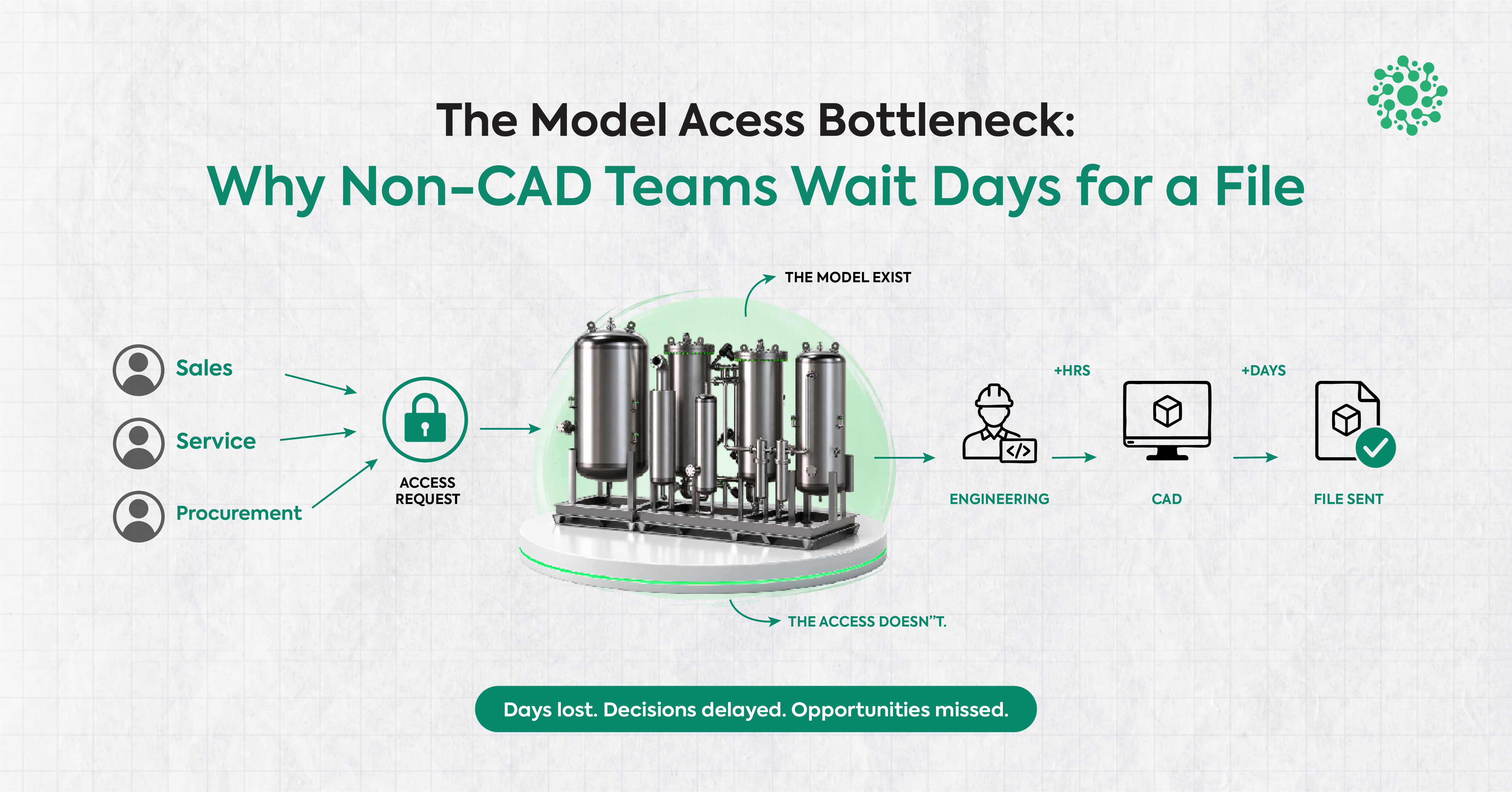
If a 3D model can only be opened by engineers with expensive, native CAD software licenses such as SolidWorks, CATIA, or Siemens NX running on high-end GPU workstations, its value across procurement, sales, quality control, and field service is crippled.
These practical realities explain why AI-generated models require a dedicated engineering delivery pipeline before they become functional business assets.
The Four Foundations of Engineering Delivery
A reliable engineering delivery pipeline rests on four core foundations, and each exists for a specific reason.
1. Format Conversion
Different CAD systems require neutral and browser-compatible formats. AI may output in one format, but downstream teams work in many. Converting to neutral formats ensures that models can be viewed across tools without losing essential geometry. This is not about replacing CAD. It is about enabling access.
2. Geometry Validation
Generated geometry must be checked before downstream use. Validation confirms that surfaces are complete, assemblies are aligned, and critical features are intact. This step prevents errors from propagating into manufacturing or supplier workflows.
3. Level of Detail Optimization
Large assemblies are simplified without sacrificing essential engineering information. Level of Detail optimization reduces polygon counts and removes unnecessary detail for specific use cases. An engineer reviewing fitment needs more detail than a sales manager presenting a concept to a customer.
4. Device-Appropriate Delivery
An engineer using a workstation and a sales manager using a tablet need different delivery experiences. Device-appropriate delivery ensures that models load quickly and interact smoothly on the hardware each stakeholder actually uses.
These foundations are not features. They are prerequisites for making AI-generated models usable across an organization.
Engineering Delivery Is More Than File Conversion
Engineering delivery extends far beyond converting file extensions. To support real-world product workflows, models must remain secure, performant, and deeply connected to the business context that gives them meaning.
- Progressive Streaming: Allows users to interact with massive, multi-gigabyte assemblies immediately in their browser while fine details load in the background, eliminating download friction.
- Interactive Visualization: Provides intuitive tools for dynamic sectioning, exploded views, precision measurement, and 3D inspection directly within the browser interface.
- Context Preservation: Models should never exist in a vacuum. A complete delivery pipeline keeps 3D geometry connected to its underlying Bill of Materials, manufacturing annotations, supporting engineering documents, and PLM metadata throughout its lifecycle.
Ultimately, engineering delivery is about preserving the usability, fidelity, and context of engineering data from initial concept through final decision-making.
Why Visualization Matters Even More in the AI Era
A common misconception is that faster model creation reduces the need for 3D visualization platforms. In reality, the exact opposite is true.
As AI accelerates model creation, organizations face an exponential increase in the volume of 3D data. Generation scales infinitely; human review capacity does not, unless visualization and collaboration tools scale alongside it.
Without an effective delivery pipeline, generated models accumulate faster than teams can evaluate them. Review cycles stall, feedback loops desynchronize, and decision-making bottlenecks worsen despite faster generation tools.
Visualization is not just looking at a 3D shape. It is the primary interface through which engineering data is inspected, validated, discussed, and transformed into actionable business decisions.
From Engineering Models to Business Decisions
Every engineering model exists to inform a decision.
That decision might be a formal design review, a manufacturing feasibility study, a supplier quote request, a customer sales presentation, or a field maintenance procedure. Each stakeholder requires a different perspective on the same asset, but all depend on accurate, performant, and contextual 3D data.
Without a modern engineering delivery pipeline, 3D models remain trapped in isolated engineering silos. The ultimate objective of product teams is not simply to generate more models, it is to make faster, higher-confidence decisions across the product lifecycle.
Building an Engineering Delivery Pipeline
Modern engineering workflows do not end when geometry is generated; that is where delivery begins.
This is where Optellix comes in.
Optellix serves as the foundational infrastructure for enterprise engineering delivery. Rather than operating merely as a lightweight 3D viewer, Optellix transforms heavy, complex CAD geometry and AI-generated models into secure, browser-based visual experiences.
- Universal Browser Access: View, inspect, and interact with complex 3D assets in real time without native CAD software or specialized plugins.
- Contextual Collaboration: Markup, annotate, and measure models directly in a shared visual environment, ensuring feedback is precisely anchored to geometry.
- Enterprise Security & Governance: Protect valuable IP with fine-grained, role-based access controls, dynamic session permissions, and secure streaming that keeps raw source files off client hardware.
- Integrated Metadata: Maintain explicit synchronization between 3D assemblies, BOM structures, and supporting documentation.
Optellix bridges the gap between model creation and organizational execution, delivering the right data, to the right stakeholder, in the right format, at the right time.
Delivery Is the Ultimate Competitive Advantage
Generative tools have permanently changed how 3D assets are created. What once took days can now be generated in minutes.
In this new paradigm, competitive advantage will no longer belong to the companies that generate the most models. It will belong to the organizations that deliver engineering intelligence seamlessly across their business to drive faster, smarter decisions.
Because the true value of an engineering model is not measured when it is created, it is measured when it empowers the right decision.
Frequently Asked Questions
Why has 3D delivery become more important as AI-generated CAD advances?
AI has dramatically accelerated model generation, but those models still need to be validated, optimized, and delivered in formats different stakeholders can actually access. Without an engineering delivery pipeline, faster generation simply shifts the bottleneck from model creation to collaboration and decision making.
What does engineering delivery mean?
Engineering delivery is the process of preparing engineering models for real-world use. It includes geometry validation, format conversion, optimization, secure access, and browser-based delivery so teams can review, collaborate, and make decisions without relying on native CAD software.
Why can't AI-generated CAD models be shared directly?
Raw CAD models often need format conversion, geometry validation, LOD optimization, and secure access controls before they're suitable for broader engineering or business workflows. Sharing them directly risks compatibility issues, performance problems, and security gaps.
What is Level of Detail, or LOD, optimization, and why does it matter?
LOD optimization reduces model complexity while preserving the information needed for a specific task. It improves performance across browsers and devices, making large engineering models easier to review, share, and interact with, without stripping out what actually matters for the decision at hand.
How do browser-based engineering platforms support AI-driven workflows?
Platforms like Optellix ingest raw or AI-generated models, run automated format conversion and optimization, and stream the geometry into secure web interfaces. This lets non-engineering stakeholders review, measure, and collaborate on models in real time, without waiting on engineering to prepare and hand off a file for every request.
.webp)
Never miss
Oops! Something went wrong while submitting the form.
Looking for Something Similar?
We have built everything from Creo plugins to AI-based VR walkthroughs. If your challenge feels like one of these — or somewhere in between — we would love to hear about it.
Feel free to share your details!
Oops! Something went wrong while submitting the form.